Features
1.Qualified to AEC-Q100 Grade 2
2.Operation frequencies: L1 Band: 1550MHz to 1615MHz,L2&L5 Band: 1164MHz to 1300MHz
3.High power gain:18.8dB@ L1 Band,19.5dB@ L2 Band,19.7dB@ L5 Band
4.Low noise figure:0.69dB@ L1 Band,0.68dB@ L2 Band,0.7dB@ L5 Band
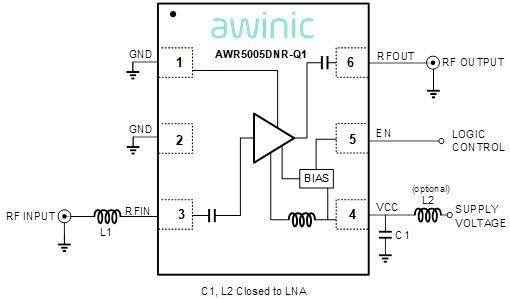
5.Requires only one input matching inductor for L1 band while additional output matching capacitor and inductor are needed for L2/L5 band
6.Supply voltage: 1.5V to 3.6V
7.DFN 1.5X1.0-6L package
8.Broadband design ensures the functionality of all GNSS signals within 1164 to 1615 MHz with the same matching
Description
The AWR5005DNR-Q1 is a Low Noise Amplifier designed for Global Navigation Satellite Systems (GNSS) as GPS, GLONASS, Galileo and Compass. With on-chip DC blocking capacitors at RFIN and RFOUT, The AWR5005DNR-Q1 can be close to the antenna, requires only one input matching inductor for L1 band while additional output matching capacitor and inductor are needed for L2/L5 band, and reduces assembly complexity and the PCB area, enabling a cost-effective solution.
The AWR5005DNR-Q1 with patented Smart Linearity Technology (SLT) achieves ultra-low noise figure, high linearity, high gain, over a wide range of supply voltages from 1.5V up to 3.6V. All these features make AWR5005DNR-Q1 an excellent choice for GNSS LNA as it improves sensitivity with low noise figure and high gain, provides better immunity against out-of-band jammer signals with high linearity, reduces filtering requirement of preceding stage and hence reduces the overall cost of the GNSS receiver.
The AWR5005DNR-Q1 is available in a small lead-free, RoHS-Compliant, DFN 1.5X1.0-6L package