Features
1 Full automotive qualification AEC-Q100 Grade1
2 16-bit I/O expander
3 I2C bus and SMBus compatible
4 Open-drain active-low interrupt output
5 400kHz I2C interface
6 1.65V~5.5V power supply
7 Configurable slave address with 2 address pins
8 Polarity inversion register
9 Low standby current consumption of 0.7μA (typical at 3.3V VCC)
10 No glitch on power-up
11 5.5V tolerant I/O ports
12 Noise filter on SCL/SDA inputs
13 Latched outputs with high-current drive capability for directly driving LEDs
14 Each I/O can be configured as an input or an output independently, default input
15 Operation temperature range: -40°C~125°C
16 Package: TSSOP-24L
Description
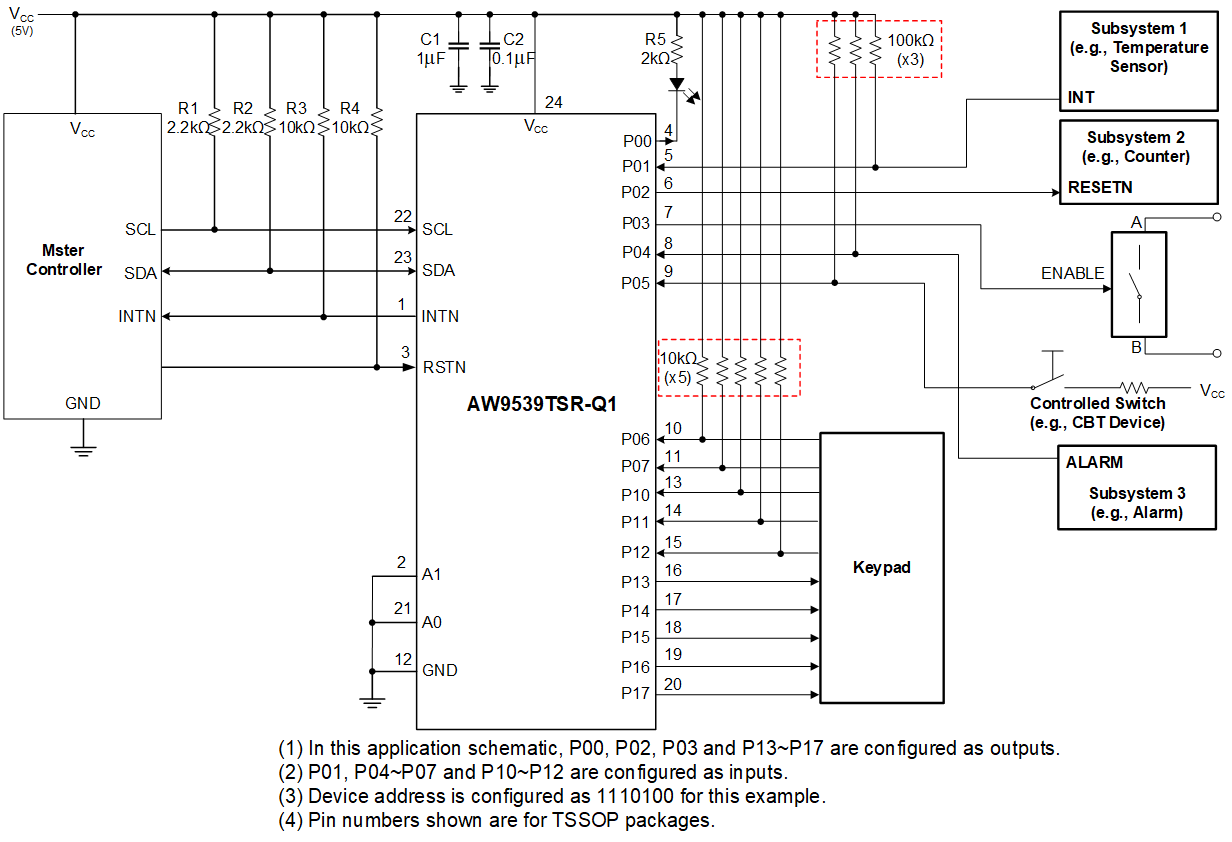
AW9539TSR-Q1 is a 16-bit I/O expander that can be controlled through the I2C bus. It provides general-purpose remote I/O expansion for most microcontroller families via the I2C interface.
The AW9539TSR-Q1 consists of two 8-bit Configuration (input or output selection), Input Port, Output Port, and Polarity Inversion (active high or active low operation) registers. At power on, all the 16 I/O ports are configured as inputs. The system master can configure each I/O as an input or an output independently by writing to the I/O configuration bits. The data for each input or output is kept in the corresponding Input or Output register. The Polarity Inversion register can invert the polarity of the Input Port register.
The AW9539TSR-Q1 open-drain interrupt output is activated when any input state differs from its corresponding input port register state and is used to indicate to the system master that an input state has changed. The power-on reset sets the registers to their default values and initializes the device state machine. The AW9539TSR-Q1 has a hardware RSTN pin that can be used to reset the device to its default state.
Two hardware pins (A0, A1) vary the fixed I2C-bus address and allow up to four devices to share the same I2C-bus/SMBus. All I/O pins are 5.5V tolerant.