Features
Features
1MHz I2C Bus
Integrated 3K Memory
12k/24k/48k input wave sampling rate
F0 detect and tracking
Advance autobrake engine integrated
Playback mode:
Real time playback
Auto dynamic sine playback
Memory playback
Trigger playback
Cont playback
Resistance-Based LRA Diagnostics
Drive signal monitor for LRA protect
Drive Compensation Over Battery Discharge
Fast Start Up Time: 0.4ms
Reused interrupt output pin
Support automatically switch to standby mode
Standby current: 2μA
Shutdown current:<1μA
Supply voltage range 2.7 to 5.5V
Short-Circuit Protection, Over-Temperature Protection, Under-Voltage Protection
Description
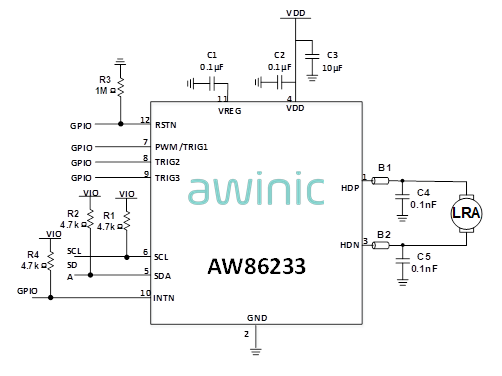
AW8623X is a low cost H-bridge, single chip LRA haptic driver, with F0 detecting and tracking based on BEMF, supporting real time playback, memory playback, Cont playback, and hardware pin trigged playback with fast start up time. All these make the AW8623X an ideal candidate for haptic driver.
AW8623X integrates a 3KByte SRAM for user-defined waveforms to achieve a variety of vibration experiences, supporting 3 sampling rate(12k/24k/48k) of waveforms loaded in SRAM, supporting output waveform sampling rate up-sampling to 48k.
AW8623X integrates an autobrake engine to suppress the aftershocks to zero for different drive waveforms (short or long) on different LRA motors.
AW8623X supports LRA fault diagnostic based on resistance measurement and protections of short-circuit, over-temperature and under-voltage.
AW8623X features configurable automatically switch to standby mode after haptic waveform playback finished. This can less quiescent power consumption. The RSTN pin provides further power saving by fully shut down the whole device. Reused interrupt output pin can detect real time FIFO status and the error status of the chip.
AW8623X features general settings are communicated via an I2C-bus interface.