Features
Voltage level translator without direction control
signal
Wide VCCA,VCCB operating range:1.1V to 5V
VCCA and VCCB are independent: VCCA may be greater than, equal to, or less than VCCB
100 pF capacitance drive capability
140 Mbps date rate for VCCA and VCCB > 1.8 V
VCC isolation feature – If either VCC input is at GND, all outputs are in High-Impedance state
OE input circuit referenced to VCCA
QFN 1.8mm×1.8mm-12L package
QFN 2.0mm×1.7mm-12L package
FOPLP 1.87mm×1.37mm-12B package
Description
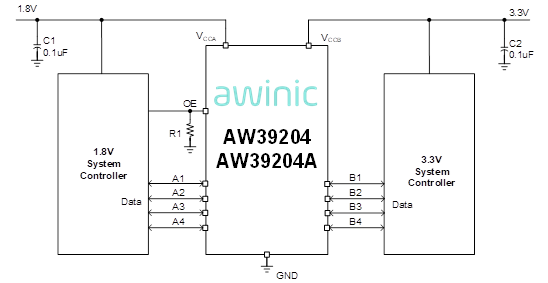
AW39204/AW39204A is a 4-bit non-inverting bidirectional voltage-level translator, it can be used to convert digital signal with mixed-voltage systems. It needs two separate power supply rails, with the A ports supporting operating voltages from 1.1 V to 5 V while it tracks the VCCA supply, and the B ports supporting operating voltages from 1.1 V to 5 V while it tracks the VCCB supply. This allows the support of both lower and higher logic signal levels while providing bidirectional translation capabilities between any of the 1.2 V,1.8 V, 2.5 V, 3.3 V, and 5 V voltage nodes.
If the voltage level of output-enable (OE) pin is low, the chip works in the high-impedance state, which significantly reduces the power-supply quiescent current consumption. And the OE input circuit is supplied by VCCA.
To ensure the high-impedance state during power up or power down, OE should be tied to GND through a pull-down resistor; the minimum value of the resistor is determined by the current-sourcing capability of the driver.