Features
● Input Voltage Range: 2.4V to 5.5V
● 2.5V minimum input voltage for start-up
● Fixed Output Voltage: 5V
±2.2% Total DC Voltage Accuracy
● IOUT ≥ 1.5A at VOUT = 5V, VIN ≥ 3.3V
● Up to 93% Efficiency
● 35μA Quiescent Current in Normal Operation
● 1μA Quiescent Current in Bypass Mode
● 4A switching valley current limit
● Light Load Power Save Mode
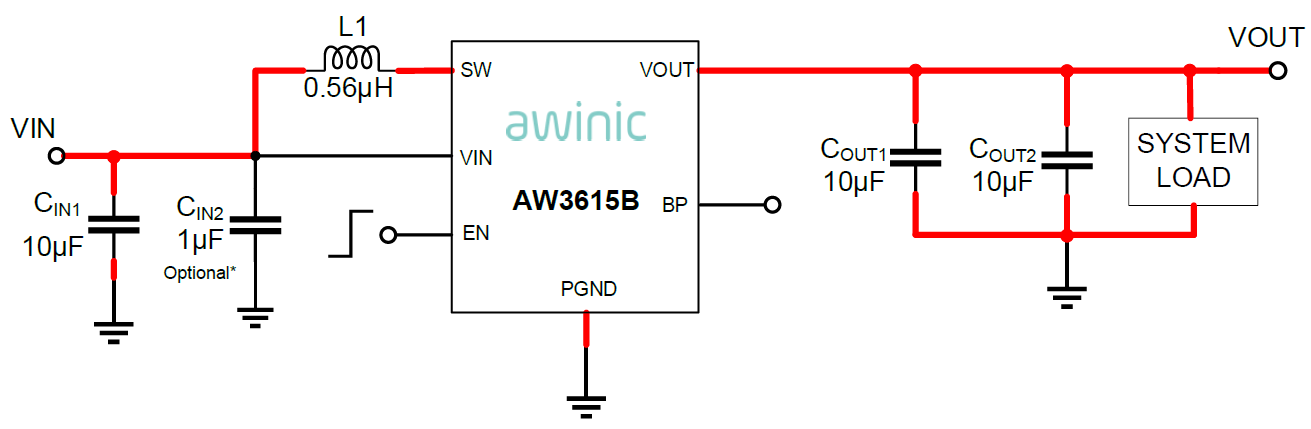
● Only Three External Components Required
● Build-in OVP, OTP, UVLO, Short-circuit Protection
● True Load Disconnect During Shutdown
● WLCSP 1.253mm x 1.253mm-9B Package
Description
The AW3615B is a large current, high-efficiency synchronous boost regulator with adjustable output voltage. With a wide input voltage range of 2.4V to 5.5V, the device supports applications powered by Li-Ion batteries with extended voltage range.
The AW3615B operates at a quasi-constant 2.5MHz switching frequency and enters power save mode operation at light load currents to maintain high efficiency over the entire load current range. The PSM mode extends the battery life by reducing the quiescent current to 44μA (typ.) during light load operation.
The AW3615B operates in pass-through mode when input voltage is higher than output voltage. When it enters pass-through mode and the device stops switching. The rectifying PMOS constantly turns on and low-side switch constantly turns off. Pulling the EN pin low and the BP pin high can force the AW3615B in bypass mode. In this mode, the quiescent current is reduced to 1μA.
The AW3615B is available in a tiny WLCSP 1.253mm x 1.253mm-9B package.