On June 23,
2026, the ribbon-cutting and commissioning ceremony for Awinic's Lingang
"Ink Bottle" Automotive-Grade Experiment and Testing Center—the
largest automotive-grade experiment and testing center in China—was held in the
Lingang New Area. Li Xiangcong, Director of the High-Tech Division at the
Lingang New Area Management Committee; Weng Wei, Party Secretary and Chairman
of Lingang Technology City Company; Sun Hongjun, Chairman of Awinic; and Lou
Shengbo, CEO of Awinic, among other guests, took the stage to cut the ribbon
and participate in the commissioning ceremony. This milestone marked the
official launch of the country's largest automotive-grade experiment and
testing platform, ushering in a new era for the localized validation of
domestically produced high-end automotive-grade chips.
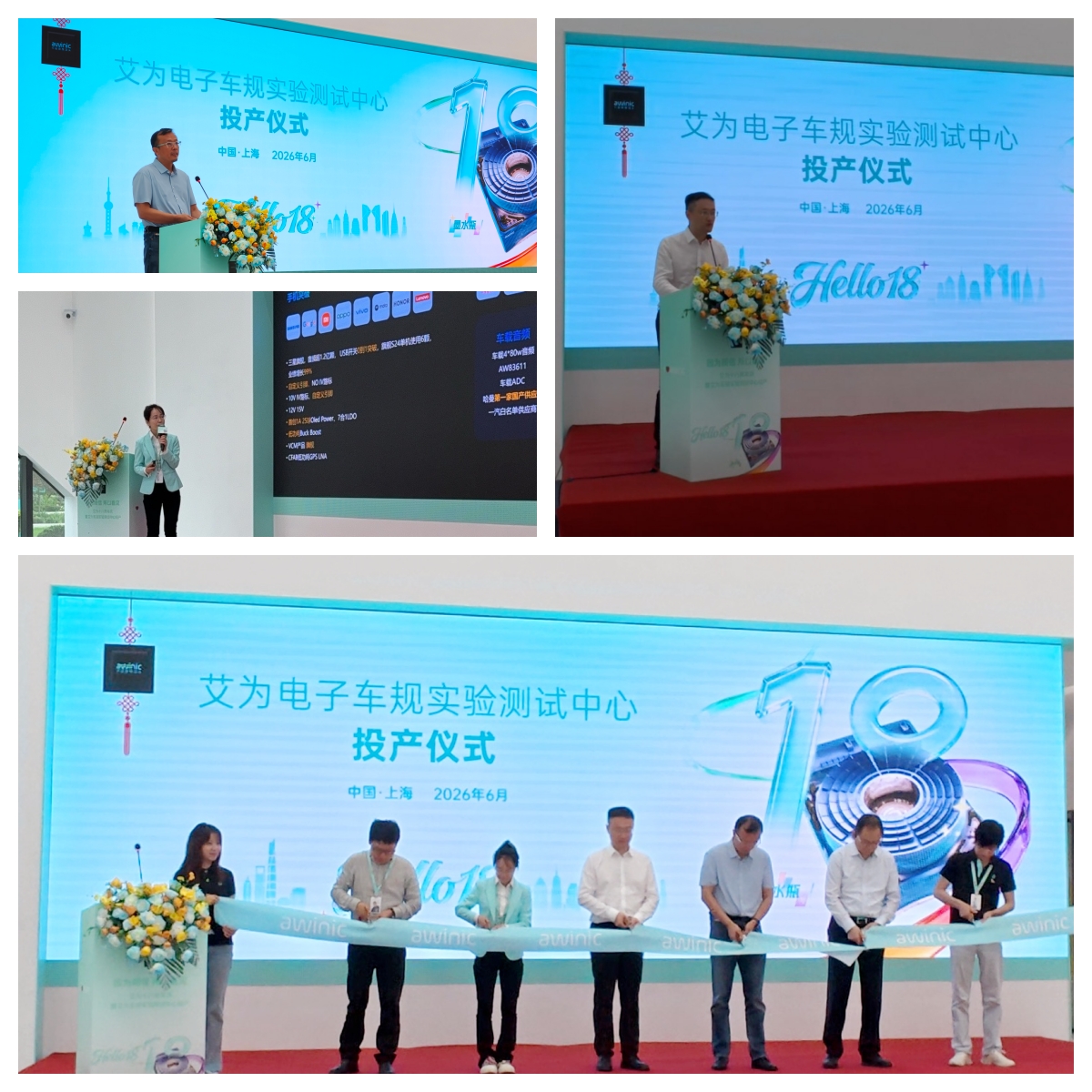
Figure 1:
Government and enterprise guests jointly witness the official launch of the
facility
As a leading
analog and mixed-signal IC company, Awinic plans an annual chip testing scale
of 30 to 50 billion units, with products spanning consumer electronics,
automotive electronics, industrial connectivity, and AI hardware. The facility,
with a total investment of 900 million RMB and a floor area exceeding 110,000
square meters, has become the largest automotive-grade experiment and testing
center in China. The project was first unveiled at the 2023 World Design
Capital Conference, and its unique "ink bottle" architectural design
embodies the vision of leveraging proprietary testing technologies to drive
innovation and development in China's semiconductor industry.

Figure 2:
Awinic's "Ink Bottle" Lingang Automotive-Grade Experiment and Testing
Center
PART 01:
Consolidating Lingang's Industrial Foundation and Addressing Key Gaps in
Automotive-Grade Testing
Sun Hongjun,
Chairman of Awinic, stated on-site that the company will fully unleash the facility's
production capacity, deepen its presence in the automotive-grade and AI chip
sectors, and continuously iterate its self-developed testing equipment.
Leveraging Lingang's industrial agglomeration advantages, the company aims to
build an industry-sharing, high-end public testing platform for
automotive-grade chips, thereby lowering the thresholds for R&D and
certification of domestically produced chips.
Li Xiangcong,
Director of the High-Tech Division at the Lingang Management Committee,
delivered a congratulatory speech at the ceremony, highlighting the area's
industrial development achievements over the past seven years: the gross
industrial output value above designated size grew from 40 billion RMB in 2018
to 450 billion RMB, a complete integrated circuit (IC) industry chain has been
established, and more than 160 new energy vehicle (NEV) supporting enterprises
have gathered in the area. Leveraging multiple policy advantages, including
geographical location, application scenarios, taxation, and the pilot free
trade zone system, Lingang continues to attract leading semiconductor
companies.
The Management
Committee also stated that it will provide full-cycle supporting services to
Awinic, allocating industrial spaces and implementing tailored policies as
needed, while regularly establishing industry chain docking platforms. At the
same time, it expressed the hope that the facility will serve as a benchmark
for smart manufacturing, strengthen quality control for automotive-grade chips,
and promote the self-reliance and control of high-end domestic automotive-grade
chips.
In terms of
industrial implementation benefits, the facility's annual testing capacity of
30 to 50 billion chips at full production can accommodate localized testing
orders for the vast majority of domestic NEV manufacturers, smart cockpit
supporting enterprises, and AI chip companies. The entire process—from sample
evaluation and engineering verification to mass production compliance
testing—can be completed locally in a closed loop. Market analysts believe that
compared with the previous model of sending samples overseas for testing,
localized one-stop verification can shorten the certification cycle for
vehicle-mounted chips by over 40%, and reduce the comprehensive testing cost
for a single chip by more than 35%. This will significantly lower R&D
validation investments for chip design companies and greatly accelerate the
iteration and deployment of domestic automotive-grade chips.
Lou Shengbo, CEO
of Awinic, introduced that the company will continue to strengthen its
intellectual property portfolio, having filed 164 patent applications in 2025,
including 53 key patents, a 40% increase over 2024. The company's business
fully covers four core tracks: consumer mobile phones, automotive, industrial
connectivity, and edge AI, with breakthroughs in large-scale implementations
for leading domestic and international brands in each field. In the consumer
mobile phone segment, the company deeply supports mass production adoption in
flagship models of major brands. In the automotive field, all five major
product lines—automotive audio, ambient lighting, RF, haptic motors, and power
& signal chain—have achieved mass production and deployment. In the
industrial connectivity sector, the company covers diverse niche markets,
including embodied robots, security, healthcare, home appliances, PCs, and
drones, securing numerous industry-leading clients. Additionally, the company
has made forward-looking deployments in edge AI, a future core track, with AI
series products such as AI companion robots, AI recording hardware, and AI
glasses. It now covers over 90% of mainstream AI glasses brands, including
Meta, ByteDance, and Rokid, earning the nickname "Little Prince of AI
Glasses." It provides end customers with comprehensive one-stop chip
solutions covering audio, motors, and power & signal chains, seizing the
initiative in the AI-driven transformation of smart hardware.
PART 02: Fully
Automated Unmanned Production Lines—Building the Core Strengths of a Lighthouse
Factory
Automotive-grade
chips are subject to stringent performance standards, imposing extremely high
demands on testing environments and equipment precision. From the civil
construction stage, Awinic's automotive-grade testing center adopted a
high-precision "three measurements, three acceptance" process to
isolate interference from temperature and vibration at the source, fully
meeting the testing requirements for high-precision automotive-grade chips and
continuously strengthening the company's service and support capabilities for
high-end chip manufacturing.
The production lines
are fully equipped with Awinic's self-developed testing equipment (including
the Honghu RF tester and Zhuque analog-digital tester), automated robots, and
intelligent warehousing systems. Through unified IoT-based management of
thousands of testing instruments, the facility enables 24/7 unmanned testing,
achieving efficiency and data stability far superior to traditional
laboratories, and establishing an energy-saving, low-carbon, and highly
efficient intelligent testing production model. The automated pilot production
line has now been debugged, with self-developed equipment scheduled for mass
production delivery by the end of 2026. After the full production line becomes
operational in 2027, the entire process—testing, sorting, and packaging—will be
unmanned, establishing the facility as a leading fully automated intelligent
verification base in China.
In terms of
business layout, the platform is firmly rooted in the automotive sector as its
core foundation, capable of undertaking testing and verification for various
automotive-grade chips. At the same time, it offers open chip testing services
for sectors including consumer electronics, industrial control, AI, broad
energy, communications, and embodied intelligence. It provides one-stop
technical services covering wafer testing, finished product testing,
reliability assessment, and failure analysis, meeting the full-lifecycle
verification needs of chip companies across multiple fields.
PART 03: Dual
Barriers in Hardware and Software, Multiple Authoritative Certifications Pave
the Way for Global Automotive-Grade Market Access
The facility has
established dual competitive barriers through its "hardware platform +
quality management system." In 2022, the center obtained CNAS laboratory
accreditation, making it one of the first chip design companies in China to
receive this qualification. In 2023, it successively achieved TUV NORD IATF
16949 automotive-grade quality certification and SGS ISO 26262 ASIL D, the
highest functional safety certification, and became one of the few IC design
enterprises in China to pass the CMMI DEV2.0 ML3 assessment. This enables the
company to deliver compliant automotive-grade software and algorithm solutions.
These multiple international certifications have paved the way for its products
to enter the global automotive market.
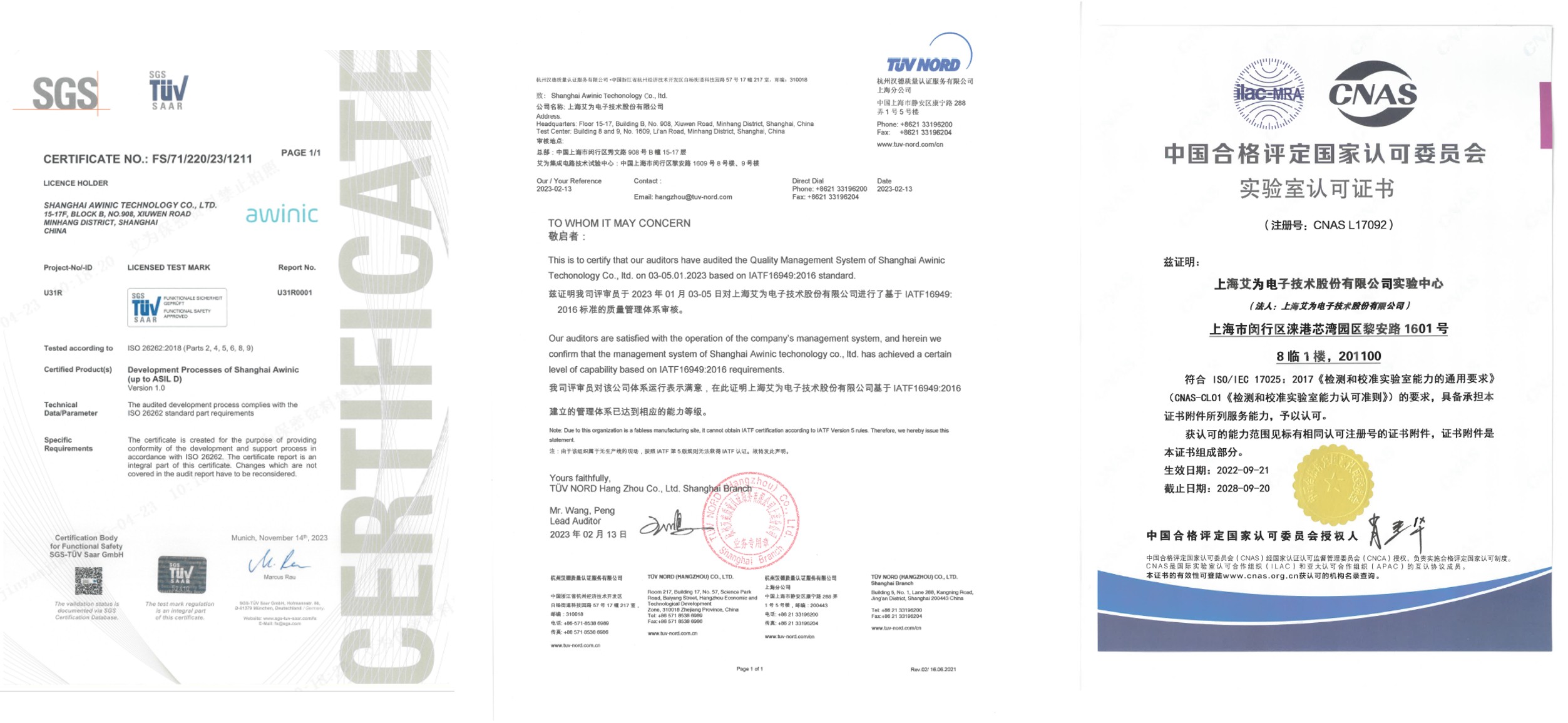
Figure 3:
Collection of Awinic's CNAS, TUV, and SGS system certifications
Notably, the
center has been designated as both the "IC Testing and Inspection Service
Platform" by the Lingang New Area and the "Shanghai IC Inspection and
Testing Pilot Platform" by the Shanghai Municipal Commission of Economy
and Informatization. These two official platform qualifications will enable the
center to deeply empower the development of the regional IC industry. At the
same time, the center is actively deepening industry-university-research collaboration
through measures such as establishing university internship and training bases,
contributing to professional teaching materials, and participating in
undergraduate talent development. These multi-faceted initiatives bridge the
gap between talent cultivation and actual industrial needs, continuously
strengthening the talent foundation and driving momentum for the high-quality
development of China's IC industry.
PART 04:
Committing to Long-Term Development Goals and Jointly Building an Independent
Ecosystem for Domestic Automotive-Grade Chips
The company will
closely align with national strategies for intelligent connected vehicles and
AI-enabled consumption. By leveraging self-developed chips and localized
verification capabilities, it will empower scenarios such as human-vehicle-home
connectivity, AI wearables, and industrial intelligence, while collaborating
with upstream and downstream partners to improve the independent
automotive-grade chip industry chain. Both the government and the company have
reached a consensus to continue deepening cooperation in the future, jointly
building a world-class IC industry cluster in Lingang. Through large-scale,
intelligent, and localized verification capabilities, they aim to support the
high-quality development of China's domestic IC and NEV industries.