With the growing popularity
of smart wearable devices today—whether TWS (True Wireless Stereo) earbuds,
smart glasses, or AR/VR headsets—wear detection has become one of the key
functions for enhancing user experience and system energy efficiency. However,
in practical usage, when a user puts on the device while it is powered off and
then turns it on, the system often fails to correctly recognize the
"worn" status. This can lead to issues such as abnormal audio
playback and touch interaction, while also preventing the device from entering
low-power mode in a timely manner. The result is unnecessary power consumption,
which significantly impacts both the user experience and the device's battery
life.
To address
this issue, AWINIC offers an effective solution that fundamentally eliminates
the "startup blind zone," enabling truly reliable wear detection and
ensuring the device "knows when it is worn."
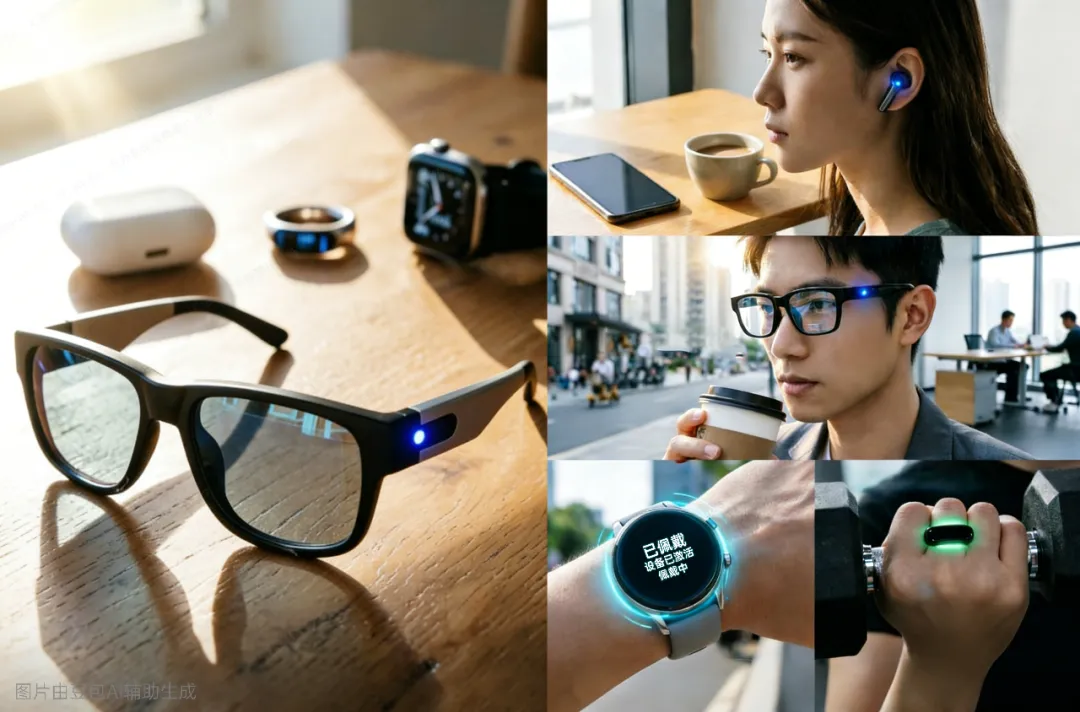
Figure 1: Application
Diagram of Wear Detection Power-On for Wearable Devices
AWINIC Wear Detection Power-On Solution
Imagine this everyday
scenario: Rushing out the door in the morning, you put on your TWS earbuds and
press the power button, only to stand there waiting for a few seconds until the
music suddenly starts — this is the interaction fragmentation caused by
power-on detection latency.
Sometimes, you have
already put on your glasses properly, but the device fails to recognize the
"worn" status and refuses to start up, leaving you fumbling to adjust
them awkwardly — this is the missed detection issue during power-on with the
device already worn.
What's more frustrating
is that after just one day, your device is already running low on battery,
simply because the background detection circuit has been idling and consuming
power — this is the battery life shortfall caused by high power consumption.
In current
power-on wear detection applications, these three major challenges are severely
hindering the enhancement of user experience.

Figure 2: Common Issues
in Wear Detection Applications
AWINIC has deeply
engaged in the field of capacitive wear detection for many
years. Leveraging mature technology, we have empowered numerous consumer
electronic products such as TWS earbuds and smart glasses, successfully
completing mass production and receiving widespread market acclaim. For
power-on wear detection applications, our solution integrates AWINIC's
self-developed "TouchSense" algorithm, completely eliminating the
"startup blind zone" inherent in traditional solutions and
significantly enhancing the interactive experience of wearable devices. The
core advantages of the solution are as follows:
Ultra-Low
Response Latency
The system activates a high-speed detection engine immediately upon power-up,
rapidly locking onto the wear status. Thanks to its ultra-low latency
architecture, the end-to-end response time from power-on to status
determination is as low as 10ms, far exceeding the industry's typical
requirement of a minimum 200ms response latency. This ensures an instant,
imperceptible interactive experience for the user.
High
Power-On Wear Detection Success Rate
Equipped with AWINIC's innovative "TouchSense" algorithm, the system
acts like an "intelligent radar," locking onto the true capacitance
baseline in real time. It maintains normal operation across various application
scenarios without the need for cumbersome recalibration processes. The success
rate for power-on wear detection exceeds 98%.
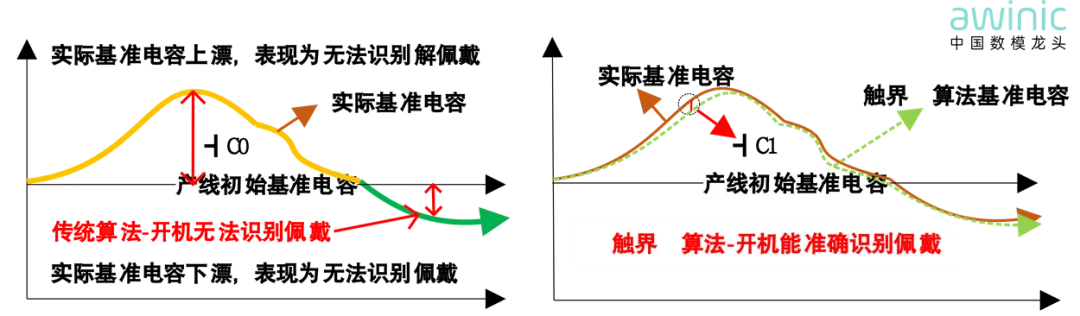
Figure 3: Baseline
Capacitance Shift Data Diagram
**In power-on wear
detection applications, the smaller the deviation from the actual baseline
capacitance, the higher the success rate of power-on wear detection. The
deviation △C1 between the baseline capacitance estimated by the
"TouchSense" algorithm and the actual baseline capacitance is
significantly smaller than the deviation △C0 between the initial
baseline capacitance and the actual baseline capacitance. This greatly improves
the success rate of power-on wear detection.**
Industry-Leading
Low-Power Strategy
Through an integrated adaptive low-power strategy, the system enables real-time
dynamic power management based on its operating state: during normal operation,
the overall power consumption is optimized to below 20μA, representing an
improvement of over 50% compared to similar products. In standby mode, power
consumption is further reduced to under 10μA, a 70% improvement, perfectly
balancing the need for high-performance detection with extended battery life.
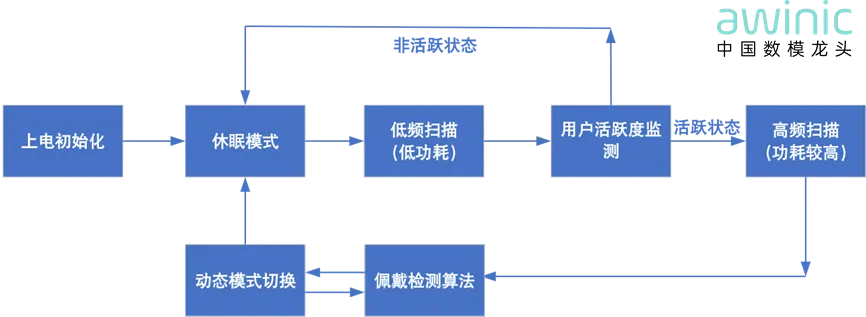
Figure 4: Low-Power
Strategy Mode Switching Diagram
Recommended Typical
Application Solutions for AWINIC Power-On Wear Detection
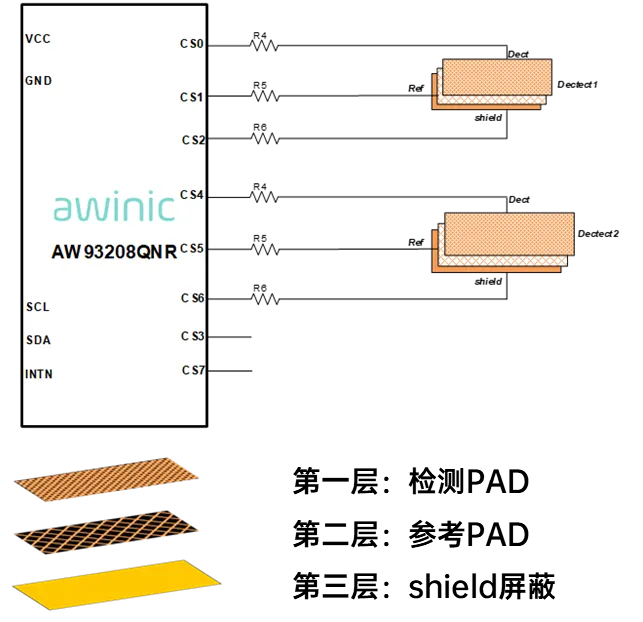
Figure 5:
Typical Application Block Diagram for Wear Detection
8-Channel, High-Sensitivity, Self- &
Mutual-Capacitance Touch
-
Capacitance Resolution: 1 aF
-
Compensation Capacitance: 220 pF
-
Button Functions: Single Click / Double Click / Triple
Click / Long Press
-
1D Sliding (Improved performance to prevent touch release
issues caused by sweat/moisture)
-
High-Performance Wear Detection (Power-on wear detection;
improved performance to prevent detection release issues caused by
sweat/moisture)
-
Program Customization / OTA (GPIO Expansion)
Low Power Consumption
-
Active Mode: 27.5 μA
-
Doze Mode: 12 μA
-
Sleep Mode: 10 μA
I2C Interface: 400 kHz,
Expandable Address
VCC Supply Voltage: 2.7V ~ 3.6V
Memory: 16KB Flash, 8KB RAM
Operating Temperature: -40°C ~ +85°C
AWINIC
Capacitive Touch Chip Selection Guide
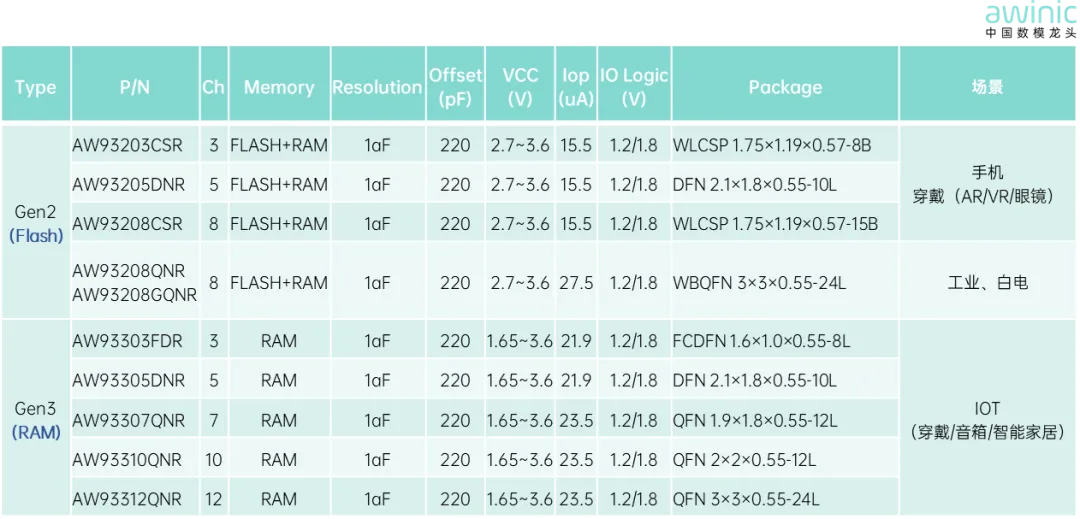
Table 5: AWINIC
Capacitive Touch Chip Selection Guide