As digital office work,
online education, and creative design scenarios continue to expand, the global
market for capacitive styluses compatible with touchscreen devices has entered
a period of rapid growth. User demand for "precise handwriting coupled with
digital interaction" is experiencing explosive growth. Particularly among
students, office professionals, and creative practitioners, the capacitive
stylus has evolved from an "optional accessory" to an "essential
tool."
The moment your
fingertips gently hold the stylus and the tip precisely glides across the
screen, the warmth of traditional writing and the efficiency of digital
technology blend perfectly—this is the new lifestyle experience brought by the
capacitive stylus.
In the
classroom, it acts as a "learning assistant": delicate pressure
sensitivity restores the authentic feel of writing, and handwriting is
automatically converted to text, making learning more efficient;
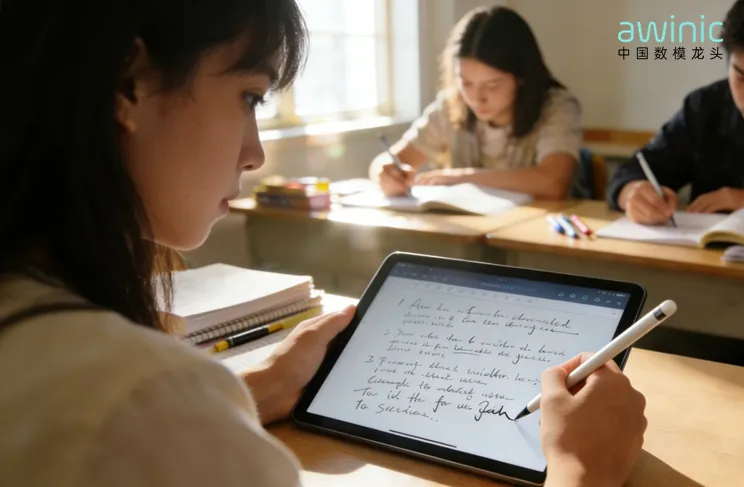
Figure 1: Classroom Usage Scenario
In the
meeting room, it serves as an "efficiency accelerator": effortlessly
jot down meeting minutes, synchronize voice recordings, and convey ideas more
precisely through remote annotations;
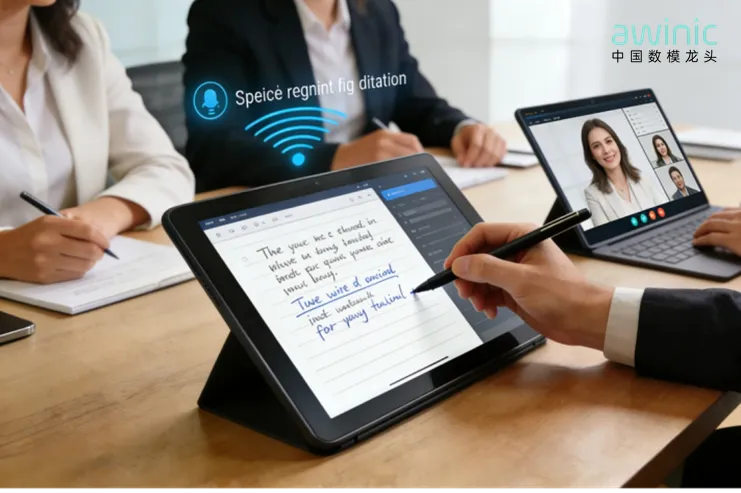
Figure 2: Office Usage Scenario
When
creating, it acts as an "inspiration catcher": high-precision
positioning combined with full-angle tilt sensitivity, delicate strokes outline
creativity, ensuring inspiration is never compromised;
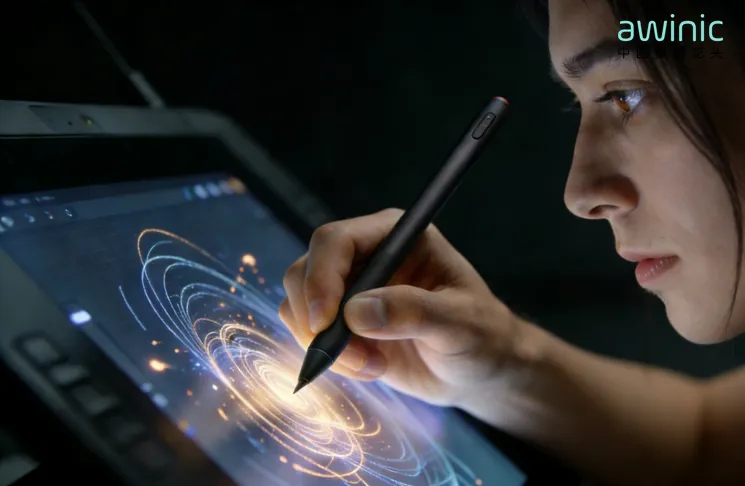
Figure 3: Creative Usage Scenario
As a
"connector" for digital life, the stylus achieves efficient adaptation
across all scenarios——
Compatible with
touchscreen devices, enabling real-time data synchronization across multiple
platforms, completely breaking down device barriers;
Equipped with fast
charging and long battery life, easily meeting all-day usage needs;
Furthermore, it
features smart handwriting recognition and dual-mode switching functions,
comprehensively covering diverse scenarios such as learning, office work,
creativity, and daily life.
From the texture of
traditional writing to the convenience of digital expression, the capacitive
stylus dissolves the gap between experiences, making every writing session both
highly efficient and imbued with the warmth of pen and paper, contributing to a
better evolution of future digital life.
The image below
shows the stylus solution launched by Awinic:
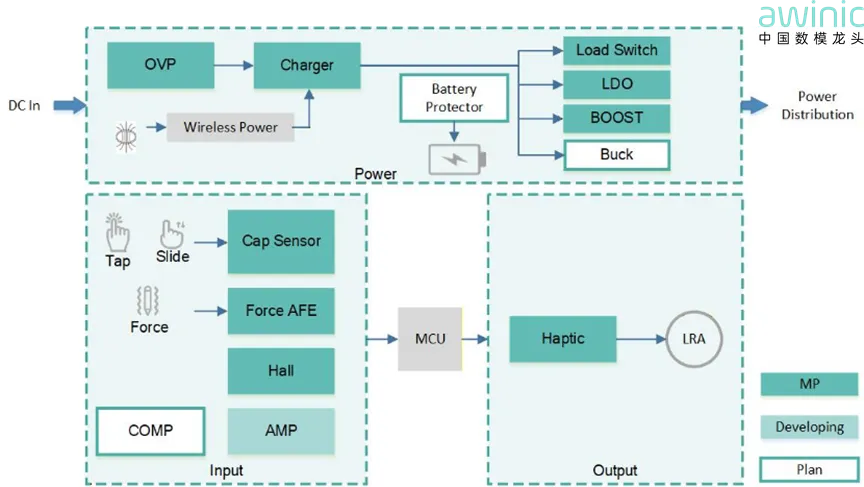
Figure 4: Stylus Application Block Diagram
Force AFE (Pressure Detection Front-End Chip)
Restoring the Soul of Varied Stroke Pressure, Just Like Pen on
Paper
Awinic's pressure
detection front-end chip is the secret weapon that enables styluses to "recreate
the feel of pen and paper." It accurately identifies minute changes in
applied pressure—a light touch creates a fine line, while a firm press delivers
a bold stroke. The response speed is fast enough to synchronize with the force
of your fingertip, allowing writing on an electronic screen to replicate the
authentic, "pressure-sensitive" texture of traditional pen and paper.
It integrates an
advanced baseline tracking algorithm and a DAC auto-calibration
function, fundamentally ensuring the stability and accuracy of the pressure
sensing performance. Furthermore, it combines advantages such as low noise,
low power consumption, a compact size, and ease of operation, giving the
stylus tip a refined sense of pressure and endowing every stroke with a unique
writing soul.
Awinic's launched low-power
pressure sensing chip, the AW8687x series, can capture pressure data with
tens of thousands of pressure sensing detection levels at high speeds,
achieving precise control over stroke thickness.
• Features a
14-bit SAR ADC
• Noise as low as 1.7µV (typ)
• ADC sampling rate up to 200K SPS
• Built-in two-stage PGA, supporting signal amplification up to 256 times
• Features a 12-bit DAC, with a maximum DC offset calibration capability of >500mV @2.8V
• Low power consumption current: 4µA @ 3.3V
• Supports baseline tracking function
• Supports DAC auto-calibration
• WLCSP 1.41X1.41-16B package
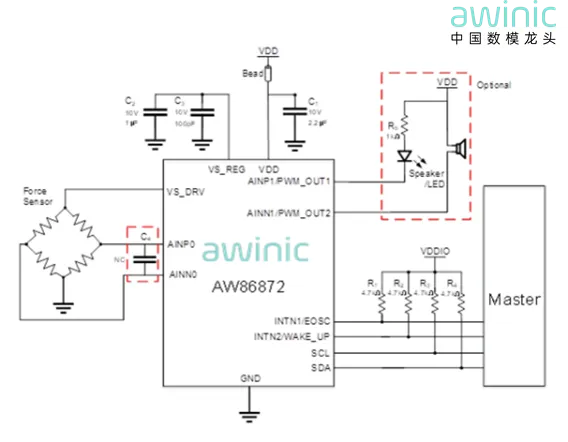
Figure 5: AW86872
Typical Application Schematic
Haptic (Haptic Feedback Driver Chip)
Giving the Stylus a "Tactile Feel" When Writing
Awinic's haptic
feedback driver chip is the "haptic magician" for the stylus. It works in
tandem with the linear motor, transforming actions like tapping and writing
into distinct vibrational sensations — a single press yields a crisp
"light vibration response," while continuous strokes provide smooth,
"detailed feedback." This creates an immersive sense of "real
touch" with every stroke, making the writing experience not just visual,
but tactile.
Furthermore, Awinic's
proprietary awinicTikTap® algorithm supports customized vibration
waveforms, allowing the motor to vibrate as desired and delivering users a
refined and precise tactile interaction experience.
In active interaction
systems, the vibration feedback is controlled by a high-performance Haptic
Driver IC. Since Awinic launched its linear motor driver IC in 2017, its Haptic
touch feedback solutions have been highly acclaimed, becoming the preferred
choice for many mainstream domestic and international manufacturers to enhance
the tactile experience of their devices.
Awinic has launched a high-performance, compact driver, the AW86235CSR, to meet the high
integration requirements of stylus applications.
• 3k SRAM,
enabling rich haptic effects
• AAE: Advanced Autobrake Engine
• LCC3.0 Sensor-Less Closed-Loop Control
• UVLO configurable from 2.4V to 2.7V
• Dynamic battery droop protection
• Supports hardware triggering
• Can automatically enter standby state
• WLCSP 1.03x1.03mm-9B package
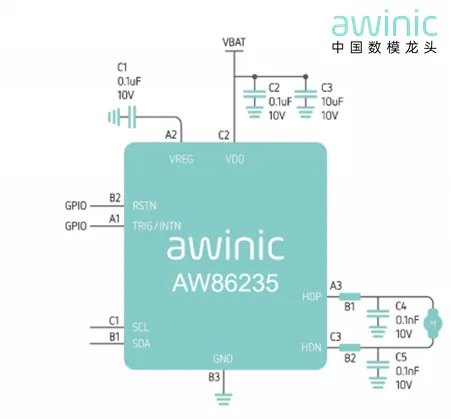
Figure 6: AW86235
Typical Application Schematic
Awinic's
Force + Haptic system solution achieves a rapid response time of less than
2ms. The pressure detection end captures and processes pressure signals in real-time.
Through a programmable trigger module, it dynamically adapts the vibration
waveform and gain to directly drive the haptic feedback unit. This
hardware-level direct, combined with low-latency circuit design in each stage,
eliminates the additional overhead of software scheduling.

Table 7: Recommended Stylus BOM (Bill of Materials)