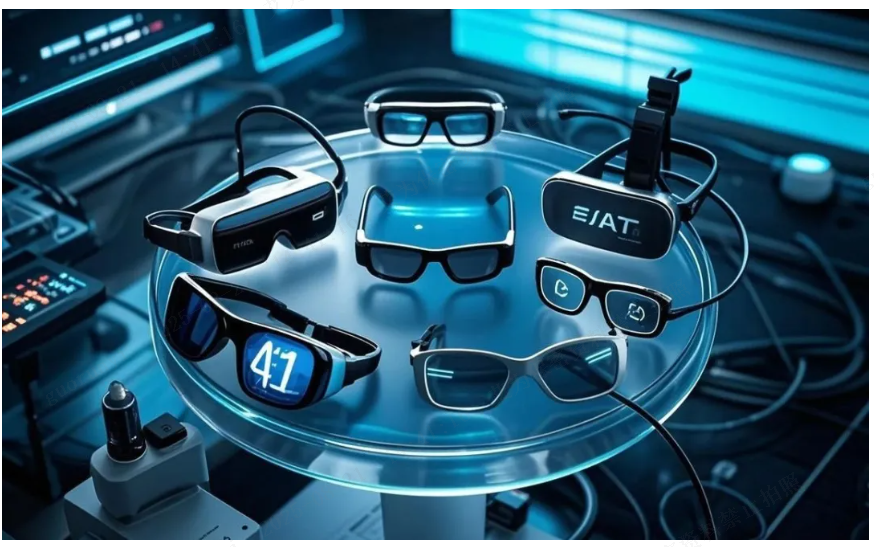
Shanji A1 Tap Mirror
On December 19th, Shanji Technology officially released the "Shanji A1 Tap Mirror" – an audio-visual AI glasses equipped with a domestic ZTE ZX Semiconductor cellular-free platform and a built-in 16MP Sony high-definition camera. Whether for travel or daily use, users can take photos or record videos by simply tapping the temple of the glasses, freeing their hands to capture every moment they see and enjoy a "seamless travel experience".
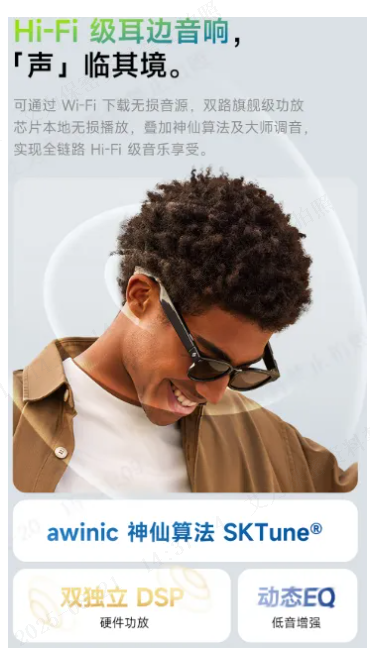
Figure 1: Awinic’s "Divine Algorithm" SKTune®
Notably, this compact pair of glasses delivers HI-FI-level audio-visual enjoyment. It adopts Awinic’s AW8816X high-performance DSP digital audio power amplifier to drive two 0920-sized speakers. Combined with the support of Awinic’s "Divine Algorithm" SKTune, it features dynamic EQ enhancement and powerful bass, offering an extremely immersive experience.
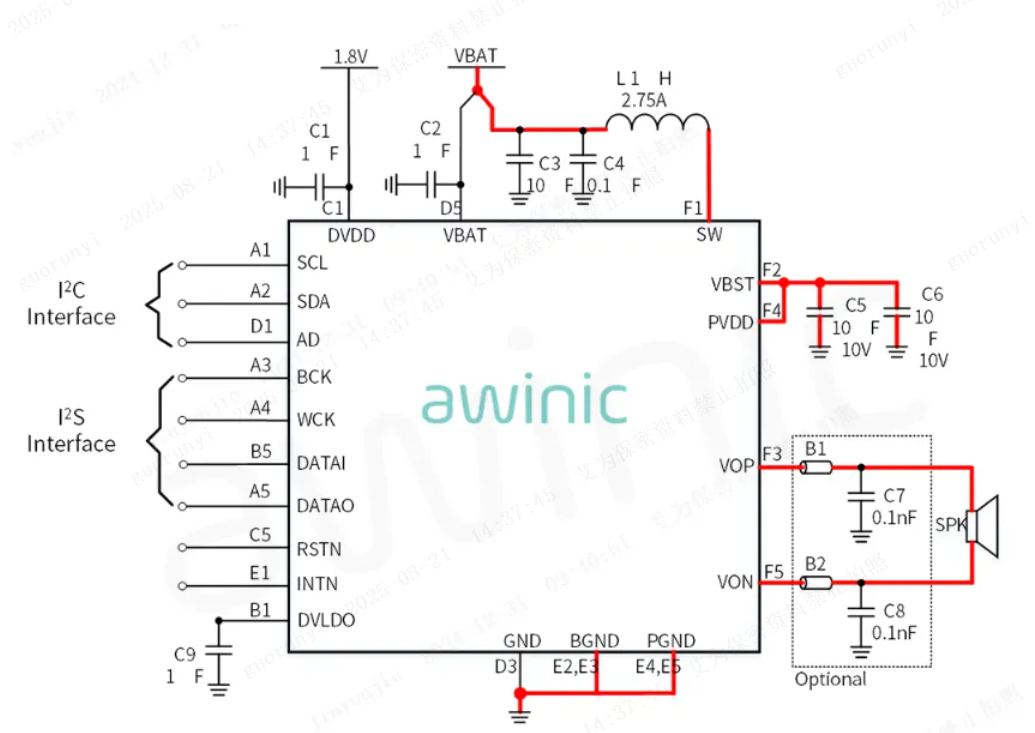
Figure 2: Typical Application Diagram of AW881X6
Features
-
Built-in DSP with SKTune "Divine Algorithm": Bass enhancement, DRC (Dynamic Range Control), EQ (Equalizer), Pop-Click prevention, voltage limiting, speaker amplitude protection, temperature protection, etc.
-
Power supply range: VBAT 3~5.5V, DVDD 1.65~1.95V
-
Smart boost efficiency up to 86%
-
Excellent RF noise suppression to eliminate TDD Noise
-
Low noise: 10μV
-
Ultra-low THD+N: 0.006%
-
Digital interfaces: I2S/TDM interface; supports 1/2/4/6/8 slots TDM; input sample rates from 8kHz to 96kHz; data width: 16, 20, 24, 32 bits; ultrasonic support via TDM/I2S running at 96kHz
-
Protection functions: Short-circuit protection, over-temperature protection, over-voltage protection, under-voltage protection
-
Compact package: FCQFN 2.0mm×2.5mm×0.55mm-22L
Awinic’s Applications in AI Smart Glasses
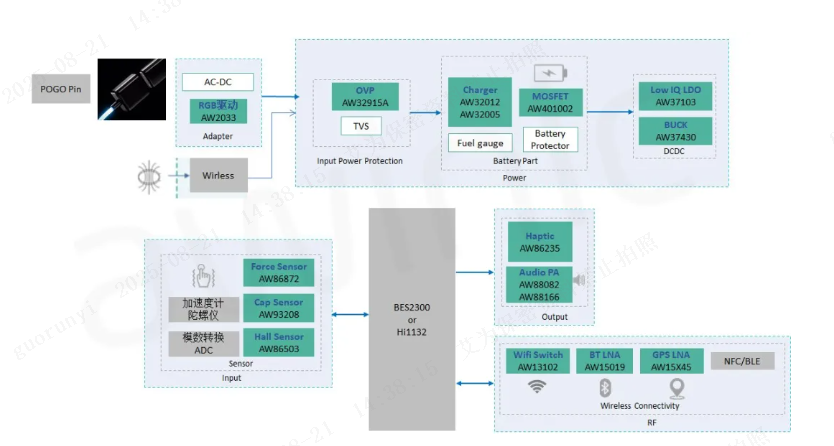
Beyond audio power amplifiers, Awinic offers a wide range of mature components for smart glasses applications, as shown below:
Figure 3: Application Block Diagram of Awinic in Smart Glasses
Below is a brief introduction to several key chips in the block diagram for reference:
Touch CAP Sensor
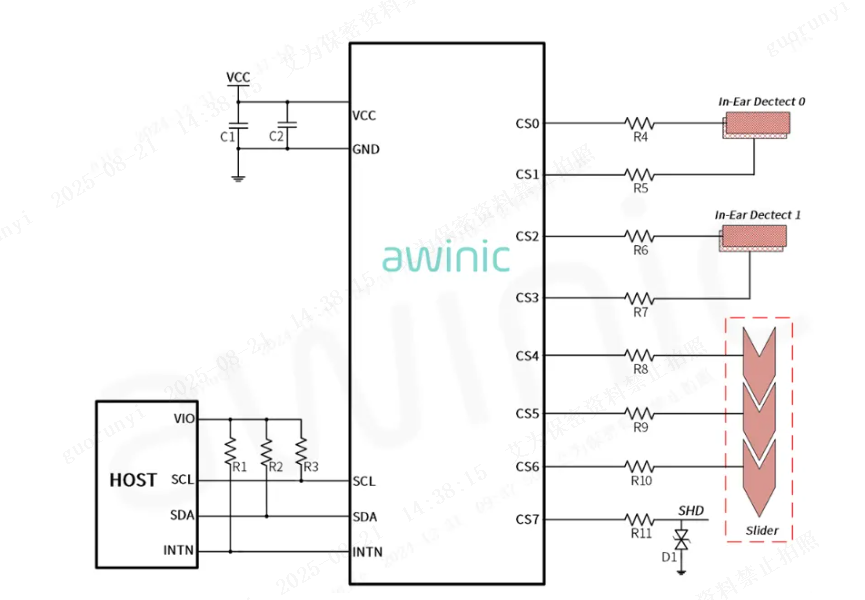
The AW9320X supports I2C control and features 8-channel touch buttons, enabling accurate recognition of wearing status and gestures such as single tap, double tap, long press, and swipe. It adopts an ultra-compact WLCSP 1.75×1.19-15B package and has an ultra-low power consumption of only 6.5μA, delivering excellent performance.
Figure 4: Application Schematic of Awinic’s 8-Channel CAP Sensor
Force Sensor
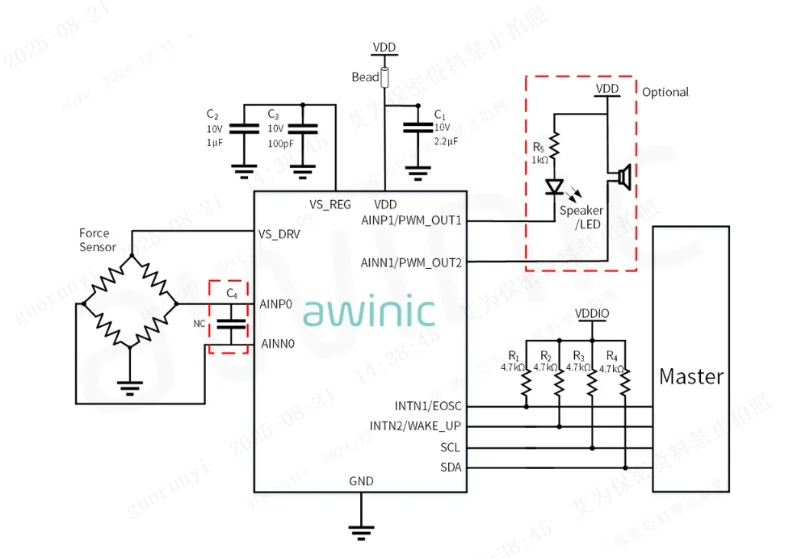
The AW8687X is controlled via I2C and includes 2 independent ASIC pressure-sensitive buttons. It supports 1.2V/1.8V I/O, with gain flexibly adjustable in 1-256 levels and a 14-bit ADC sampling rate of 150Ksps. Housed in an ultra-small WLCSP 1.41×1.41×0.34-16B package, it has extremely low power consumption – only 10μA under 10Hz/2-channel conditions. This force-sensitive solution effectively prevents false touches and optimizes the user experience.
Figure 5: Application Schematic of Awinic’s Force Sensor AFE
Linear Charging IC
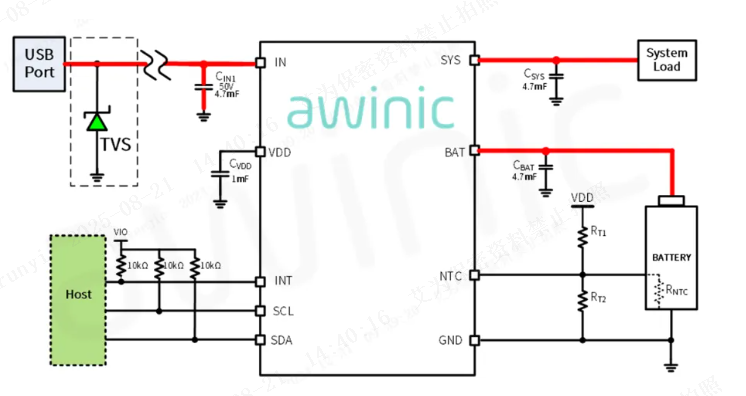
The AW3201X boasts significant advantages: its charging current can be flexibly configured from 2mA to 500mA, with a maximum DC voltage tolerance of 28V and a charging accuracy of up to ±0.5%. It supports Powerpath and shipping modes and adopts an ultra-compact WLCSP 1.4×1.4×0.63 package. Its quiescent current (IBAT_Q) is only 5μA, placing its self-power consumption at the industry’s top level and greatly extending standby battery life. The 1-31mA charge termination current ensures the battery is fully charged, enhancing overall performance.
Figure 6: Application Schematic of Awinic’s Linear Charging IC
Breathing Indicator LED Driver
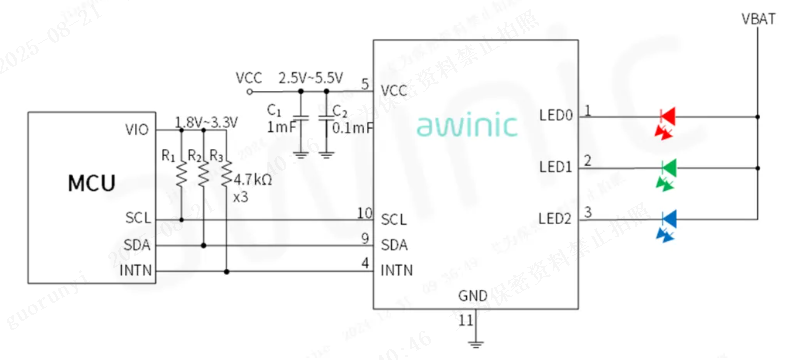
The AW202X can drive 3 channels of LEDs or a single RGB LED. It offers 4 levels of global maximum current configuration (5-30mA), enabling 4096-level color mixing and 256-level dimming per channel. It also features an independent breathing mode and a standby current as low as 2μA. The RGB breathing indicator function intuitively displays the device’s working status.
Figure 7: Application Schematic of Awinic’s 3-Channel RGB LED Driver
Over-Voltage Protection (OVP)
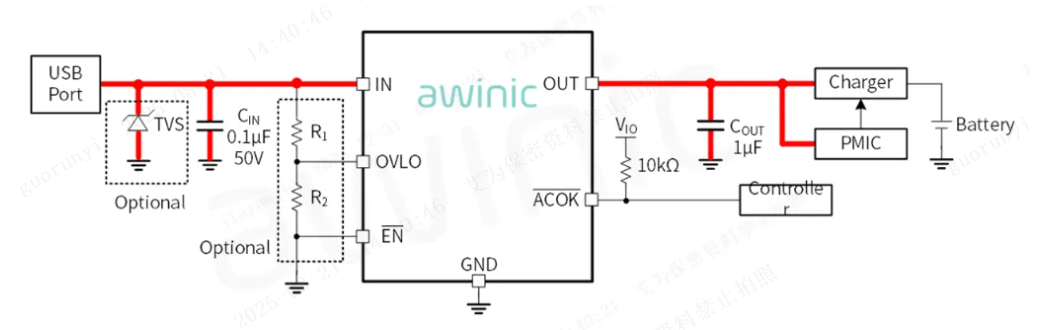
The AW3291XA delivers outstanding performance: its over-voltage protection (OVP) threshold is flexibly configurable between 4V and 24V, with an on-resistance as low as 27mΩ and a maximum continuous over-current capability of 5A. It has a built-in 100V surge protection capability and 29V DC voltage tolerance, and can quickly respond to shutdown within 100ns. This effectively blocks surges and ensures charging safety at all times.
Figure 8: Application Schematic of Awinic’s Charging Port OVP
Next, we will explain the development stages and application advantages of AR/AI glasses.
Development History of AI Glasses
-
Attention-Grabbing Stage (2012): Google launched Google Glass, the first smart glasses, which attracted widespread attention. Equipped with a display, camera, speaker, and other functions, it supported voice recognition and cloud computing – marking a milestone in the development of AR glasses.
-
New Direction Exploration Stage (2015 onwards): After Google Glass was discontinued, AR/VR glasses emerged but faced issues such as heavy weight, low practicality, limited application scenarios, and poor battery life. These challenges drove manufacturers to continue exploring new forms of smart glasses.
-
Rapid Development Stage (2023 onwards): In 2023, the smart glasses co-developed by Meta and Ray-Ban achieved great success, with annual sales exceeding 1 million units, demonstrating strong market potential. This inspired many tech companies including Apple and Samsung to enter the market. Launched products include "Rokid Glasses" (a collaboration between Rokid and BALON), Xreal Air2, Baidu’s "Xiaodu AI Glasses", TCL Nubia AIR2, and Meizu Star V Air2. These products all highlight the broad market space of smart glasses and their status as a key battleground for tech companies in the future.
-
Future Outlook Stage: With the boom of AI large models (such as Doubao, ERNIE Bot, etc.), AI glasses will move towards deeper integration with AR technology to achieve more natural and effective human-computer interaction and a more complete ecosystem. Meanwhile, issues related to battery life, computing power, and weight will be addressed to enhance the user experience – paving the way for a future surge in demand.
Figure 9: Development History of Smart Glasses
Advantages of AI Glasses
-
Portability: They can be worn daily like ordinary glasses, enabling "use anytime, anywhere". Free from the constraints of handheld devices, they support seamless operations such as checking map navigation while driving or referencing recipes in real time while cooking.
-
Efficient Information Interaction: Via voice interaction and connection to AI large models, users can inquire about the weather, check device parameters, access real-time translation, and participate in meetings or training sessions.
-
Photo & Sharing: By activating the glasses’ built-in camera, users can take photos or record videos without taking out their phones. The first-person perspective captures unique shots and preserves precious moments.
-
Augmented Reality Experience: The built-in camera allows users to scan items to obtain information directly, making shopping more intelligent and rational and enabling a new smart life experience.
Conclusion
AI technology is transforming our lives – and we are all witnesses to this change. Awinic will continue to deepen its expertise in developing high-quality analog and mixed-signal chips, commit to providing one-stop solutions, lead new trends in industry development, drive technological progress and innovation, and make smart life accessible to all.
Some images in this article are sourced from the Internet, and their copyright belongs to the original authors. In case of copyright issues, please contact the background of the "Awinic Home" WeChat official account to negotiate relevant matters.