Awinic has launched the 6th-generation normal-voltage linear motor driver, AW86246, specifically designed for linear motor driving. As a rare Haptic-dedicated driver IC supporting dual-power supply, it balances system power consumption and performance. Equipped with essential haptic feedback functions such as upgraded Automatic Braking (AAE) and F0 automatic calibration/tracking, it also adds the LCC 3.0 (Linear Resonance Actuator Consistency Calibration) function, enabling small-sized motors in smartphones, wearables, and other devices to deliver optimal performance.
Since the launch of its linear motor driver IC in 2017, Awinic’s Haptic feedback solutions have been widely favored. Major Android smartphone manufacturers at home and abroad have adopted these solutions to enhance the haptic experience of their devices. Meanwhile, fields such as AR, VR, notebooks (NB), IoT, and automotive have also leveraged Awinic’s linear motor driver ICs to create 4D haptics. With exceptional product strength and ultimate customer service, over 600 million devices worldwide have been equipped with Awinic’s linear motor driver ICs.
Figure 1: Application Scenarios
Over the past few years, Awinic has focused on the development of linear motor drivers, and its Haptic products have become a trusted partner for high-end flagship devices. Currently, Awinic’s Haptic products have entered 9 out of the world’s top 10 smartphone OEMs. Awinic is also committed to developing Haptic driver products suitable for a wider range of product forms, bringing better products and more convenient designs to customers, and richer and more natural haptic experiences to users.
Features
-
Wide voltage input range: 2.7~5.5V
-
Low UVLO (Under-Voltage Lockout): 2.4V
-
Supports LCC 3.0 function
-
Supports AAE 2.0 (Automatic Braking 2.0)
-
Supports Q-factor detection
-
Supports motor internal resistance detection
-
Supports Smart Loop function for small-sized motor applications
-
Ultra-fast response time: 0.4ms
-
Standby current: 2μA @ DVDD, 0.5μA @ VDD
-
UVP (Under-Voltage Protection), OCP (Over-Current Protection), OTP (Over-Temperature Protection) functions
Table 1: Package Information
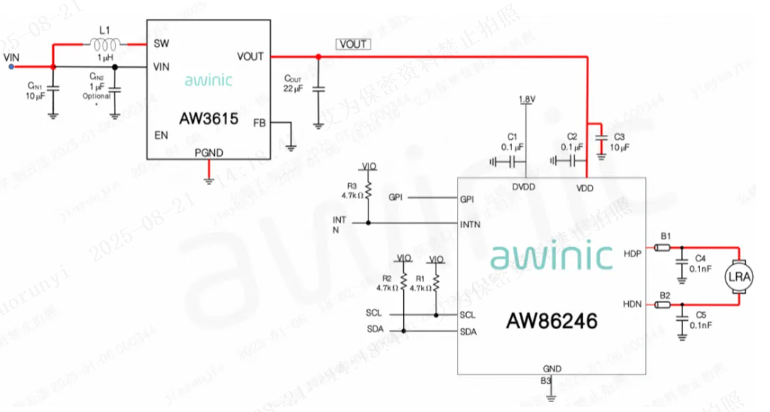
Figure 2: Typical Application Diagram of AW86246
Key Highlights
Dual-Power Supply
Traditional linear motor driver ICs only support single-power supply, and terminal manufacturers usually choose direct VBAT (battery voltage) supply. The AW86246 offers users two power supply options: it can use an external 5V boost supply – high-voltage supply delivers a better short-vibration experience, and the short-vibration effect does not change as the battery voltage decreases. Alternatively, users can choose direct VBAT supply or LDO (Low-Dropout Regulator) supply based on actual application scenarios.
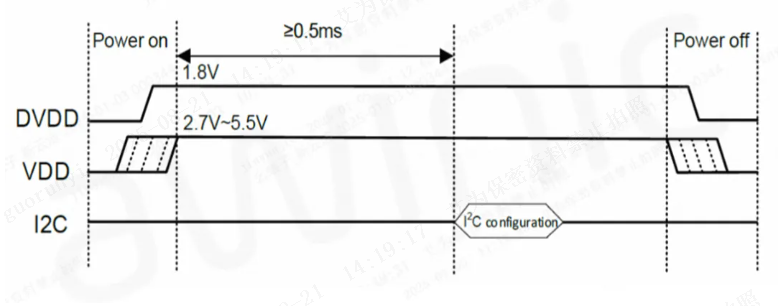
The power-on sequence of VDD and DVDD is not restricted. Since the digital logic and SRAM are powered by DVDD, VDD can be powered off after vibration is completed, achieving a perfect balance between vibration performance and power consumption.
Figure 3: Power-On/Off Timing Diagram
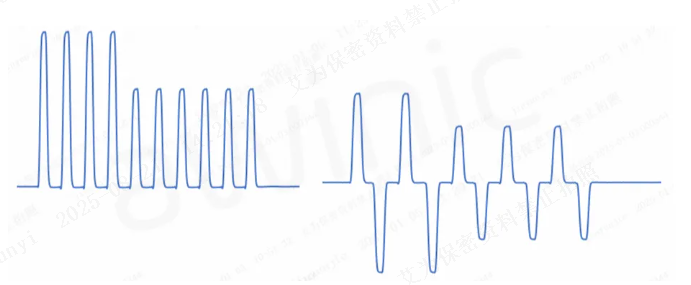
Advanced Automatic Braking 2.0 + Fast Start Algorithm
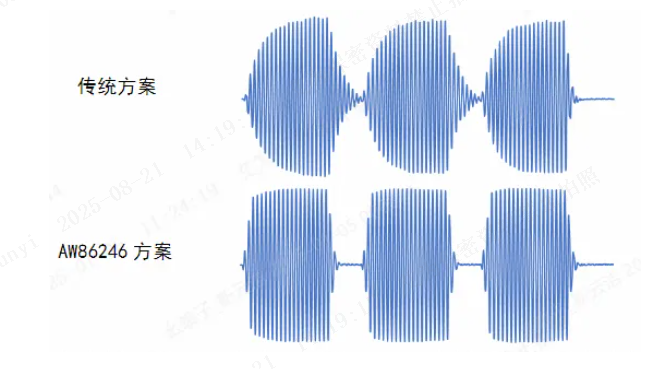
Traditional AAE 1.0 can only perform braking at the end of the waveform, which has significant limitations. However, AAE 2.0, combined with Awinic’s unique control algorithm, enables braking at any time. The AW86246 can detect more motor parameters; when paired with the fast-start function exclusive to Awinic’s Tiktap algorithm, it can perfectly achieve square-wave vibration. The figure below compares the handling of continuous long vibrations between traditional solutions and the AW86246 solution.
Figure 4: Acceleration Waveform Comparison Between Traditional Solution and AW86246 Solution
Vibration Consistency (LRA Consistency Calibration, LCC 3.0)
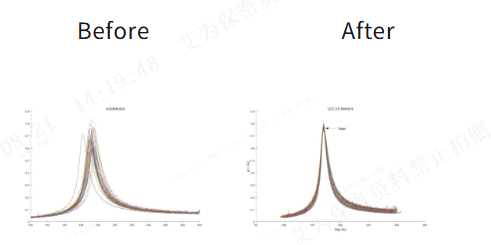
Due to factors such as materials, production processes, and specification control, even linear motors from the same production batch exhibit significant individual differences. A frequency-sweep test on a mainstream linear motor model on the market showed that the fundamental frequency and vibration amplitude of different motors in the same batch varied greatly – this is the main cause of inconsistent user experiences.
When the LCC 3.0 algorithm of the AW86246 is adopted, under the same test conditions, individual motor differences are offset, and the consistency of vibration performance is improved by 50%.
Figure 5: Frequency Response Curves
Smart Loop Function
As linear motors in smart wearables become increasingly small, the accuracy of F0 (resonant frequency) detection has become a more prominent issue. The newly added Smart Loop function effectively addresses this pain point. The actual test comparison is shown in the figure below:
Figure 6: 0412 Motor - Disable SmartLoop vs. Enable SmartLoop
Some images in this article are sourced from the Internet, and their copyright belongs to the original authors. In case of copyright issues, please contact the background of the "Awinic Home" WeChat official account to negotiate relevant matters.