In the booming mobile game industry, mobile game peripherals have upgraded from "optional accessories" to "core equipment". Among them, mobile phone capacitive waterproof shoulder triggers, with features such as no physical contacts, low-latency response, and IP68 waterproof rating, have become the first choice for professional mobile game players.
Technical Evolution Background: The Inevitable Transition from Mechanical to Capacitive
Traditional physical shoulder triggers for mobile games have the following three major pain points:
-
Mechanical wear (button lifespan is about 500,000 times)
-
Waterproof defects (difficult to obtain IP68 certification due to physical gaps)
-
Space occupation (single button occupies >35mm³)
In terms of application schemes for mobile game shoulder triggers, the main differences between capacitive waterproof shoulder triggers and traditional physical shoulder triggers are as follows:
Technical Challenges of Capacitive Shoulder Triggers: Main Technical Requirements for Game Shoulder Triggers
Capacitive detection mainly relies on detecting changes in capacitance to determine whether it is a button touch. The amount of change in the detected capacitance is highly related to the actual pressing contact area and the dielectric constant on the detection electrode.
Considering the complexity of users' operations in game scenarios, the actual contact area of each press is inconsistent, and there may be the possibility of edge touch (the edge contact area is small, and the signal change is small). A single threshold detection scheme cannot cover all contact scenarios. On the other hand, after long-term use, sweat from human hands will remain on the surface of the detection electrode, making the capacitance change larger than that in dry scenarios, increasing the risk of false triggering. At the same time, after long-term use, the temperature of the detection electrode surface will rise, which will also have a greater impact on the detection results.
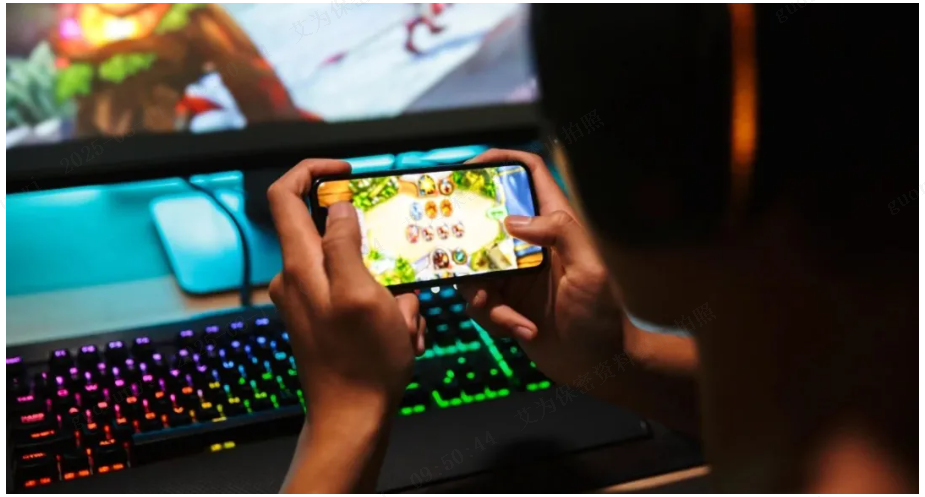
Based on the above description, the specific technical difficulties faced by capacitive game buttons can be summarized as follows:
-
Fast Response and Full-Area Triggering
-
Dry hand quick click: The response time needs to reach more than 100Hz to ensure no perceived lag in continuous clicking operations.
-
Edge pressing: It is necessary to realize the pressing recognition of at least 1/3 of the key surface (the sensitivity decreases by 30%~50% due to signal attenuation at the edge of the electrode).
-
Stable Recognition in Complex Environments
-
Operation with water/sweat: Maintain >95% recognition rate under 0.1~0.3ml liquid residue (simulating the state after washing hands without drying).
-
Anti-interference from posture changes: When the finger slides/rolls and presses, the contact area will change, and the signal characteristics are unstable.
-
Refined Trigger Control
-
Light touch recognition: The finger can be recognized when lightly placed on the contact surface.
-
Slow pressing: Recognizable at a speed ≥0.2mm/s.
-
Stable long press: No disconnection for more than 10s.
-
Anti-false triggering when suspended: Induction distance ≤2mm (accuracy ±0.3mm).
Awinic Game Shoulder Trigger Algorithm Scheme: Dayu Waterproof Algorithm
In the application scenario of capacitive game shoulder triggers, Awinic has a self-developed mature algorithm scheme - Dayu Waterproof Algorithm. This algorithm scheme is a special scheme custom-developed to deal with various problems in game scenarios. At present, it has been applied to mobile game shoulder triggers, and the market feedback is good. The technical characteristics of the scheme are as follows:
-
The refresh rate can reach more than 500Hz, meeting the demand for fast response;
-
It supports up to three levels of sensitivity adjustment to adapt to different groups' requirements for response speed;
-
High-precision discrimination is realized through the feature recognition of pressing signals, which improves the recognition accuracy in water and sweat scenarios;
-
A stepwise segmented threshold setting strategy is adopted to adapt to button triggering under different gestures;
-
Adaptive baseline adjustment strategy to ensure stability during long-term use;
-
Water volume prediction scheme: According to the signal characteristics, predict the residual water volume of the button, and adopt a specific baseline strategy to deal with the scenario of excessive residual water volume.
-
Algorithm Module Framework
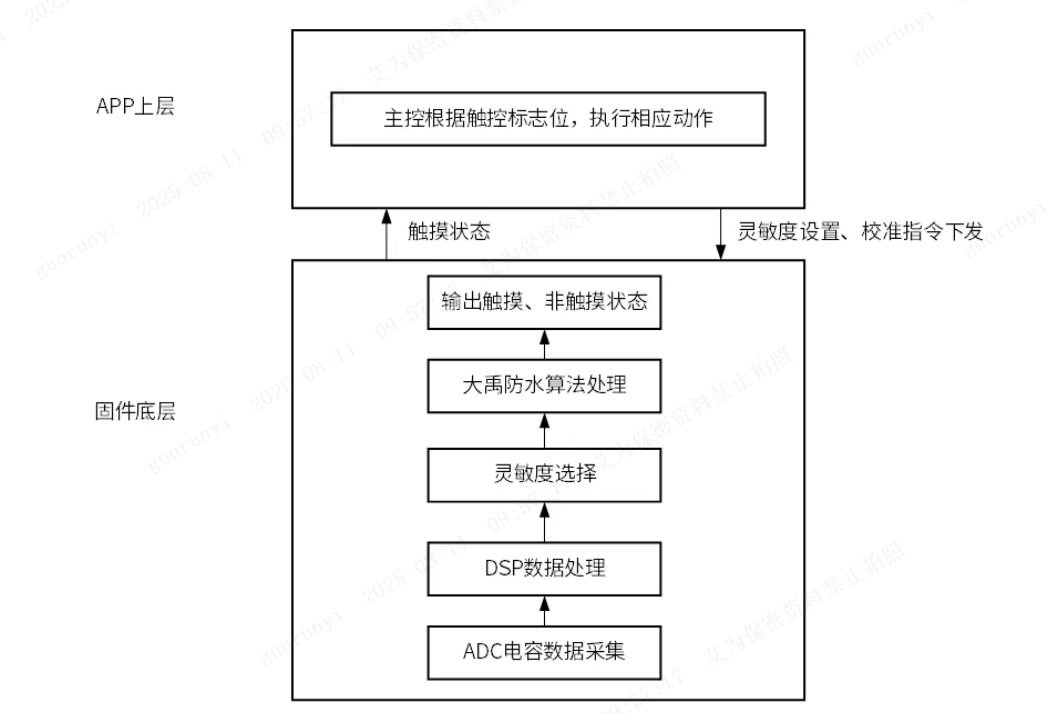
This scheme is implemented in the underlying firmware. The upper layer can calibrate the initial capacitance state and set the sensitivity by sending commands. The underlying firmware, after a series of algorithm processing, outputs the touch and non-touch states after algorithm judgment for the upper layer to process. The algorithm module block diagram is as follows:
Picture 1 Algorithm Module Block Diagram
-
Data Display in Typical Application Scenarios
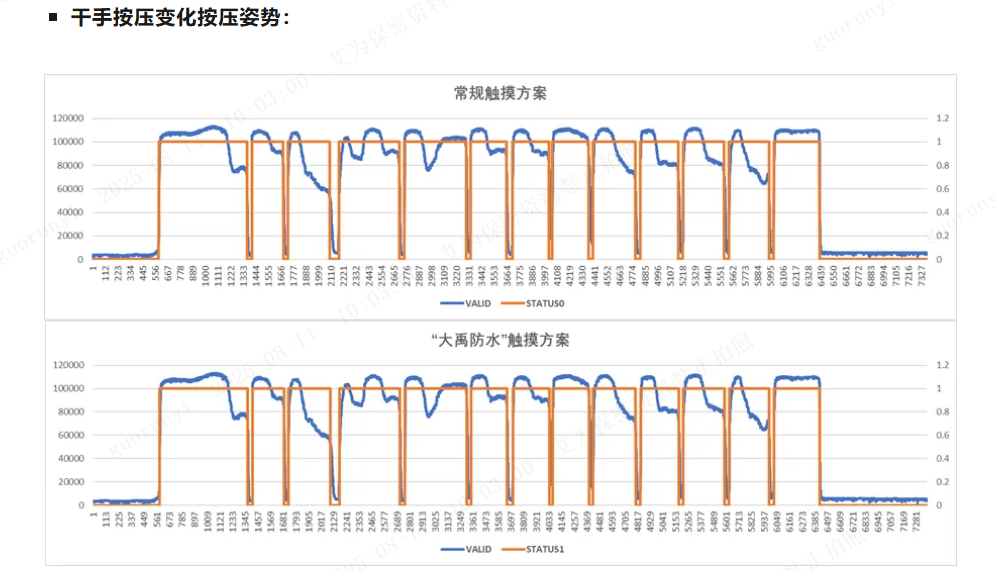
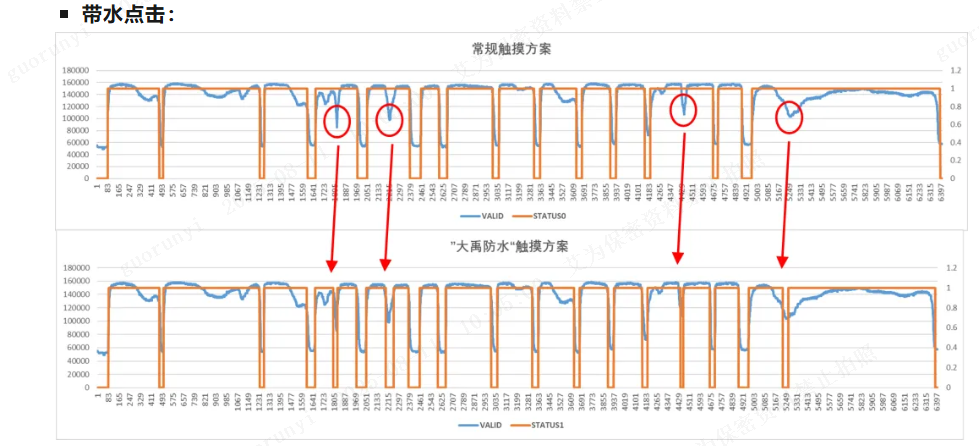
Tests were carried out for several typical operation methods in the game shoulder trigger scenario, and the data characteristics are as follows (VALID represents the effective signal amount, STATUS0 represents the touch state of the conventional touch scheme, and STATUS1 represents the touch state of the "Dayu Waterproof" touch scheme):
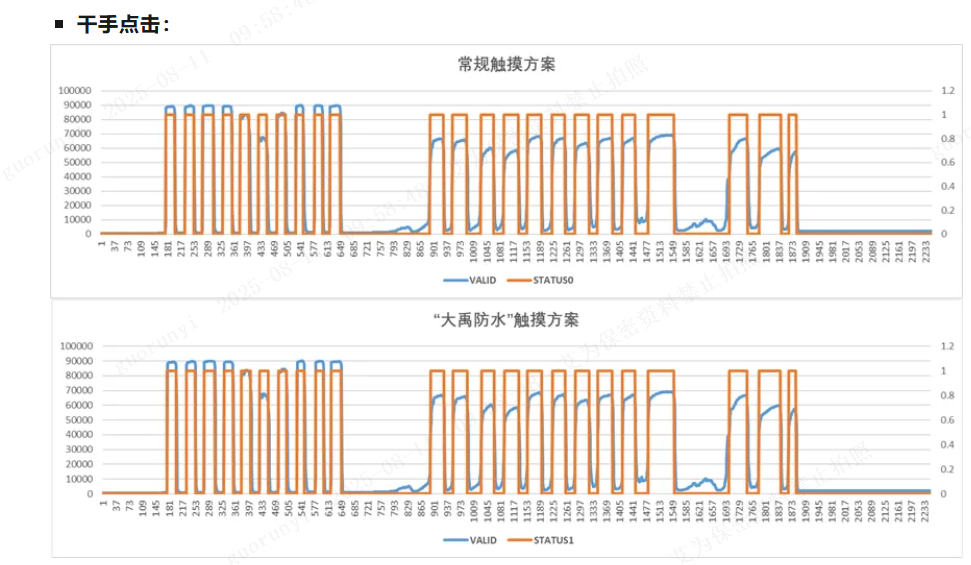
Picture 2 Dry Hand Click
Dry hand pressing with changing pressing posture:
Picture 3 Dry Hand Pressing with Changing Pressing Posture
Clicking with water:
Picture 4 Clicking with Water
From the test results of typical scenario data, it can be seen that:
-
The "Dayu Waterproof" algorithm scheme is better than the conventional touch scheme in waterproof performance. In the scenario with water stains, it is more sensitive to the change of data trend and easier to capture the hand leaving action;
-
The "Dayu Waterproof" algorithm scheme can also achieve the same touch effect as the conventional touch scheme when the hand is dry.
-
Demonstration of Actual Measurement Effect
Implementation of Awinic Game Shoulder Trigger Scheme: Chip Selection
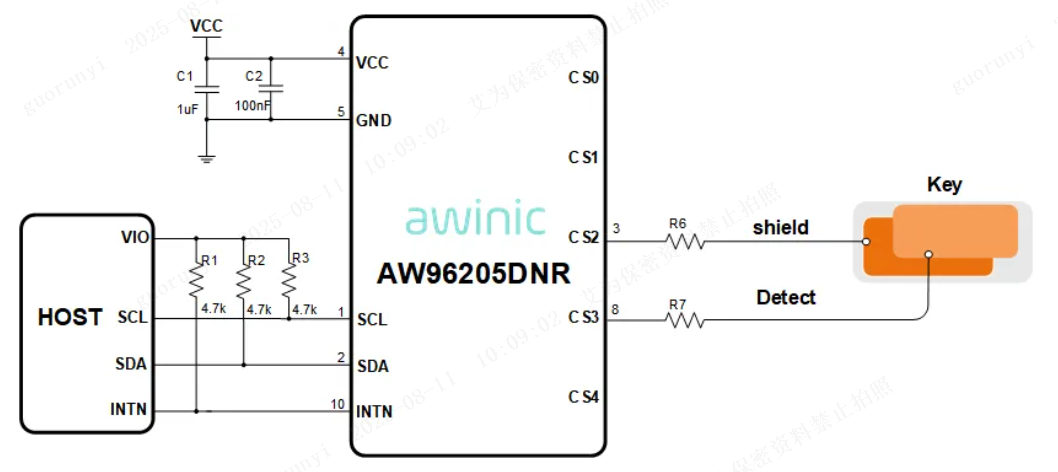
The algorithm for Awinic game shoulder trigger application is integrated into the AW96205DNR series chips. The main characteristics of this chip are as follows:
Picture 5 AW96205DNR Application Block Diagram
Introduction to Chip Characteristics
5-channel High-sensitivity Cap Sensor
-
Capacitance resolution: 1aF
-
Compensation capacitance: 220 pF
-
High-performance adaptive temperature compensation algorithm
-
"Dayu" waterproof and sweatproof algorithm
-
Flexible program, supporting customization
-
10,000 online upgrades (OTA)
Low Power Consumption
-
Active: 22uA
-
Doze: 6.7uA
-
Sleep: 5.5uA
-
Deep Sleep: 2.5uA
I²C: 400 kHz, address expandable
VCC: 2.7~3.6V
Memory: 16kB Flash, 8kB RAM
Temperature: -40°C~85°C
About Awinic
Leading Digital-Analog Company in China
Shanghai Awinic Electronics Technology Co., Ltd., founded in 2008, focuses on the design of high-performance digital-analog mixed-signal, power management, signal chain and other ICs. It successfully listed on the Science and Technology Innovation Board of the Shanghai Stock Exchange in August 2021, with the stock code 688798.
Awinic Electronics has accumulated more than 40 product subcategories and nearly 2,000 product models in total. The performance and quality of its products have reached the industry-leading level. The company's products are widely used in consumer electronics, industrial internet and automotive markets, including smart phones, tablet computers, notebook computers, smart wearables, smart speakers, smart home appliances, mobile payments, internet of things, AI education, smart toys, servers, new energy, robots, drones, security, automotive electronics and other fields.
In 2024, the company's R&D investment was 510 million yuan, accounting for nearly 17% of the revenue. Technical personnel accounted for more than 74%. It has accumulated 649 domestic and foreign patents, 125 software copyrights, and 595 integrated circuit layout registrations.
Awinic Electronics has been awarded the National Enterprise Technology Center, the Single Champion Enterprise in the audio manufacturing industry, the National Intellectual Property Advantage Enterprise, "National High-tech Zone Listed Company Innovation Top 100", Shanghai Innovative Enterprise Headquarters, Shanghai Quality Gold Award, Shanghai Municipal Design Innovation Center, Shanghai Intelligent Audio Chip Technology Innovation Center, Shanghai Hardcore Technology Enterprise TOP 100 list and other qualifications and honors.