Recently, at the annual Lenovo Innovation and Technology Conference, Lenovo Lecoo Douzhanzhe G1 Shooting AI Glasses and Lenovo V1 AR Smart Glasses were officially released.
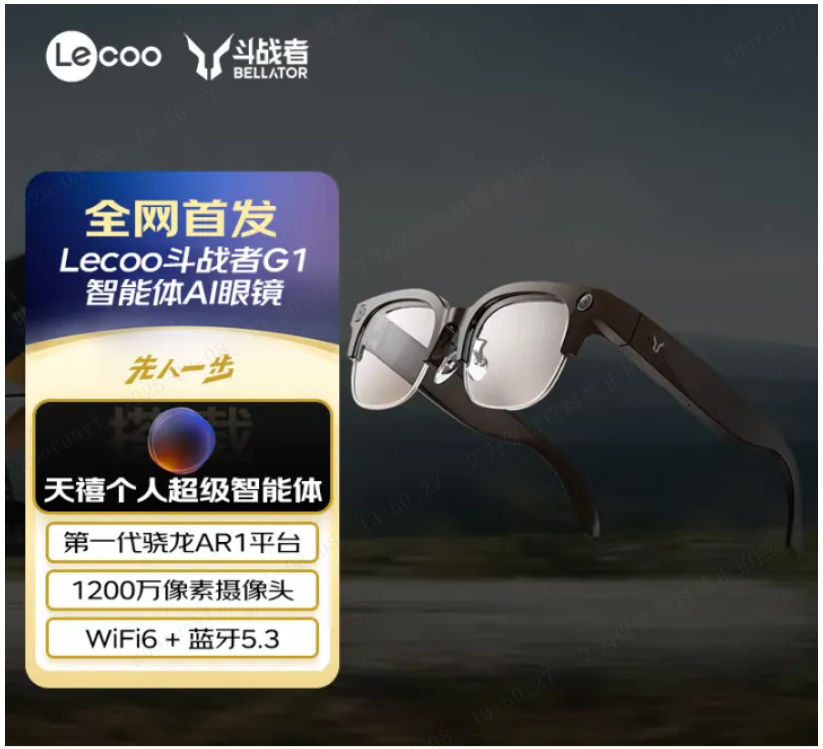
It is reported that the Lecoo Douzhanzhe Shooting AI Smart Glasses have strong hardware configurations. They are equipped with the same Qualcomm Snapdragon AR1 platform as Meta-Rayban and a Sony IMX681 image sensor, with the camera capable of taking 12-megapixel photos. In addition, the product supports WIFI 6 + Bluetooth 5.3, enabling low-latency transmission and smooth connection with multiple devices. The 173mAh battery can support 4 hours of long battery life. The 5-microphone array has strong noise reduction and accurate voice recognition capabilities. In terms of ID appearance design, it adopts a semi-rimless design with high recognition.
In terms of AI capabilities, the Lecoo Douzhanzhe G1 is equipped with Lenovo's self-developed Tianxi personal super intelligent agent, supporting AI translation, AI dialogue, and AI image recognition functions. It is currently available for pre-order on
JD.com.
Picture 1 Lecoo Douzhanzhe AI Shooting Glasses (Image source: JD Mall)
The Lecoo Douzhanzhe G1 AI Shooting Glasses bring users an excellent human-computer interaction experience. Its external sound effect is as clear as if the sound is close to the ear. The touch buttons for playback and photo-taking operations are sensitive and convenient. The flickering prompt of the RGB colorful light when shooting brings a unique interactive experience.
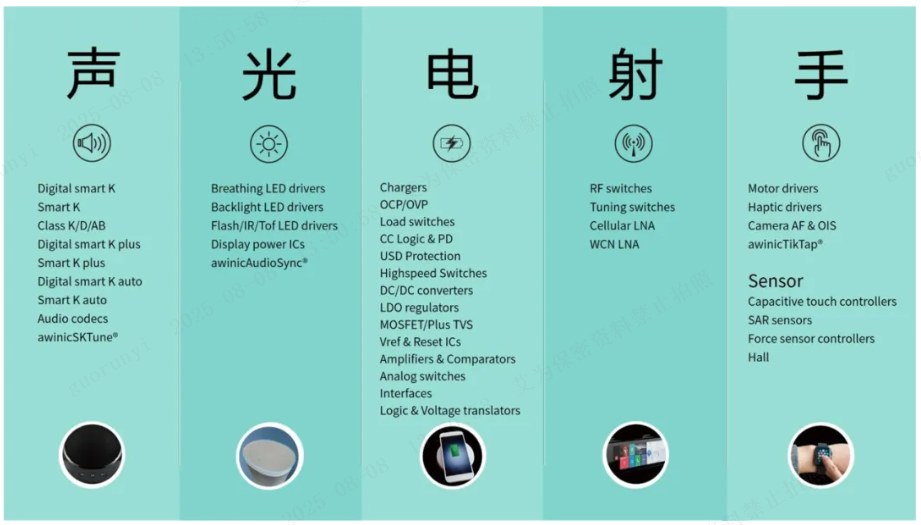
In the realization of interactive functions, Awinic's "sound", "light" and "hand" have played an important role. In terms of "sound", Awinic's normal-pressure digital power amplifier is adopted, which presents pure and natural sound, bringing users a high-quality audio experience. In the design of "light", Awinic's industry-leading small-package RGB lamp driver is used, which can realize 16 million color mixing and 256-level dimming breathing effects, with rich and delicate light changes. In the control of "hand", Awinic's 8-channel touch chip is adopted, supporting two-point wearing detection and sliding gesture recognition. The operation is simple and smooth, and the corresponding functions can be easily completed with one touch, which greatly improves the convenience and interest of interaction.
Picture 2 Awinic's product layout of audio, optical, and touch products
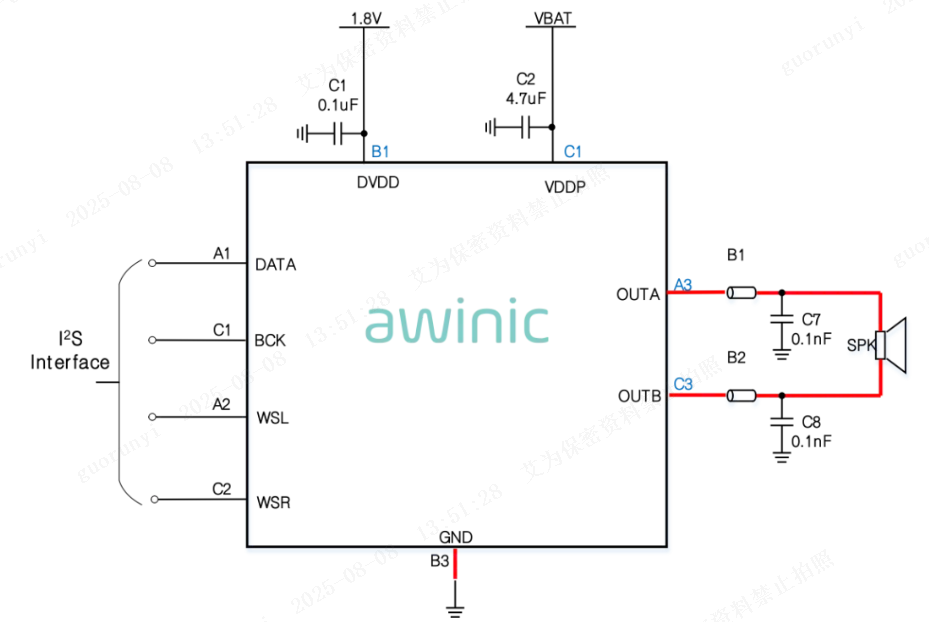
Typical Specifications of Digital Audio Power Amplifier
■Power supply range: VDDP 2.5~5.5V, DVDD 1.65~1.95V
■Low noise: 9μV
■Ultra-low THD+N: 0.016%
■Digital interface:
I2S interface, supporting 2 slots
Sampling rate: 32kHz~48kHz
Data bit width: 32 Bits
Left and right channel selection and channel mixing
■Package specification: WLCSP 1.34mmX1.48mmX0.6mm-9B
Picture 3 Typical application circuit diagram of digital audio power amplifier
Its channel configuration is flexible, and it adopts an extremely small package design, which is perfectly suitable for glasses and other wearable products. In addition, digital audio power amplifiers with DSP specifications are also available for users to choose, meeting diversified needs.
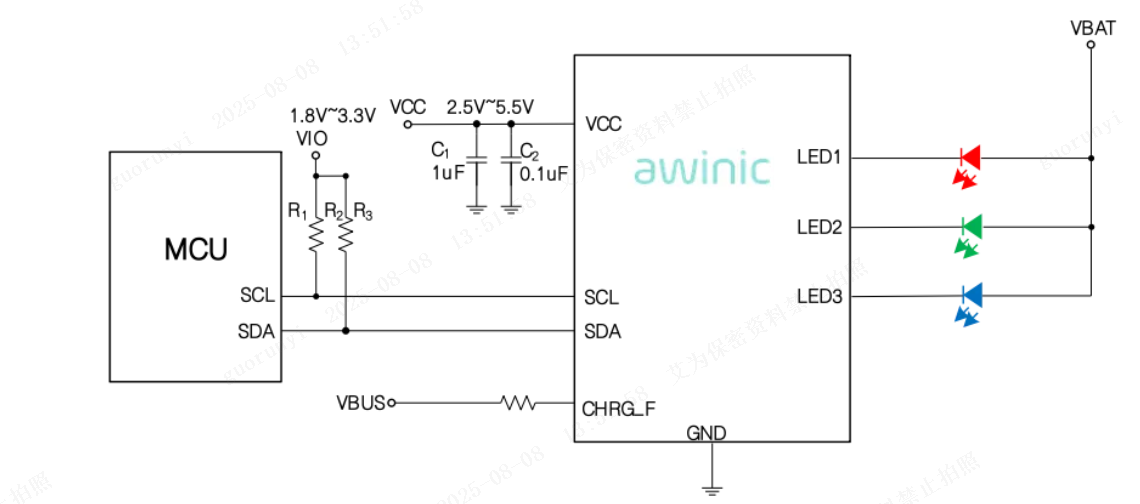
Typical Specifications of RGB Lamp Driver
The product performs excellently in terms of lamp driving. It can support driving 3 single-color lamps or a single RGB lamp, and has a 4-level global current configuration function of 3-25mA, adapting to different power consumption needs. It has significant advantages in color mixing and dimming, supporting up to 256×256×256 color mixing levels and 256 PWM dimming, creating brilliant and colorful breathing or flickering light effects, adding unique charm to the product.
In terms of operating mode and power consumption control, it supports autonomous breathing mode without occupying the main control IIC, which greatly optimizes the operating efficiency. In Standby mode, the power consumption is as low as 5uA, with remarkable energy-saving effect. The application of current source type SINK drive control technology effectively ensures high consistency of brightness and color between individuals. In addition, the dedicated CHRG_F function is very considerate, which can realize charging indication in the shutdown state, bringing users a convenient use experience.
Picture 4 Typical application circuit diagram of RGB lamp driver
Typical Specifications of Touch Chip
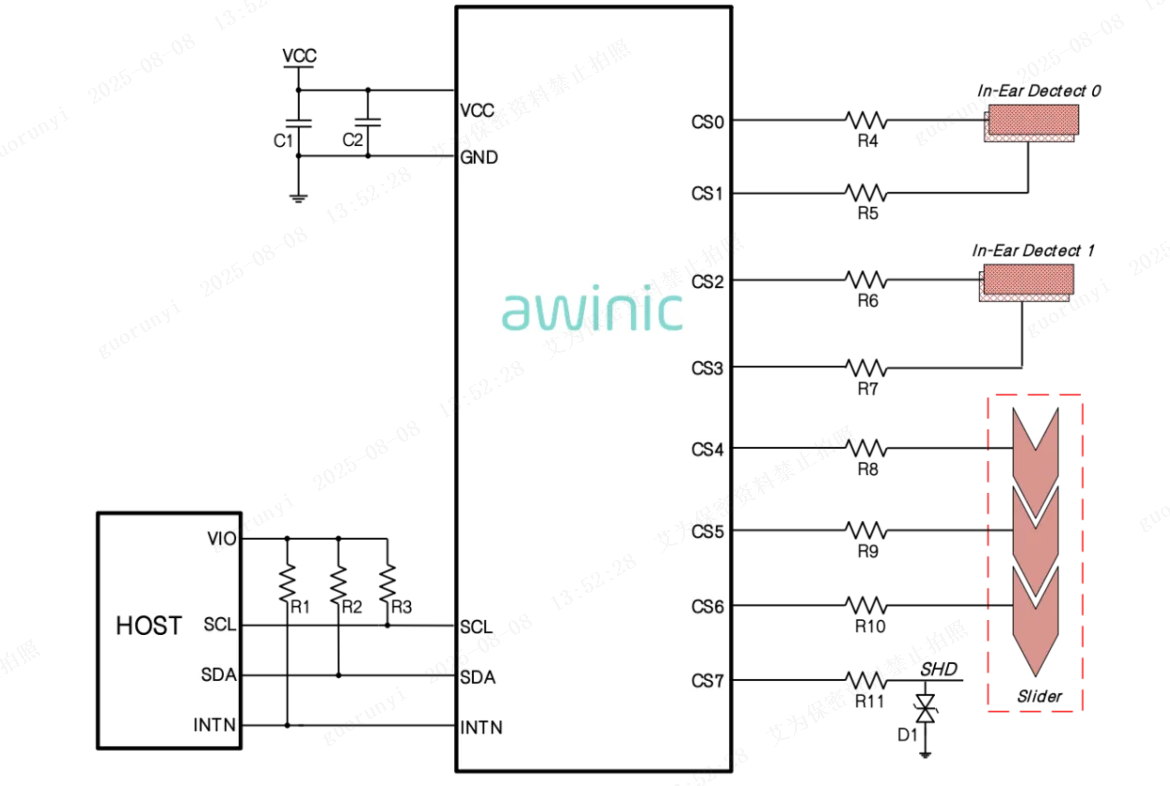
Adopting I2C control mode, equipped with 8-channel touch buttons, it can realize accurate recognition of various operations such as wearing detection, single click, double click, long press, and sliding, greatly improving the interactive experience. In terms of package and power consumption, it adopts WLCSP 1.75*1.19-15B ultra-small package, with extremely low power consumption of only 6.5uA, which not only saves space but also effectively reduces energy consumption and improves product battery life.
Picture 5 Typical application circuit diagram of touch chip
Thanks to the significant advantages of Awinic's touch chips in multi-channel adaptation, waterproof and temperature compensation algorithms, many glasses solution companies have included Awinic's touch chips in their design schemes. In the future, more upcoming glasses models will use Awinic's touch products.
Other Materials for AI/AR Glasses
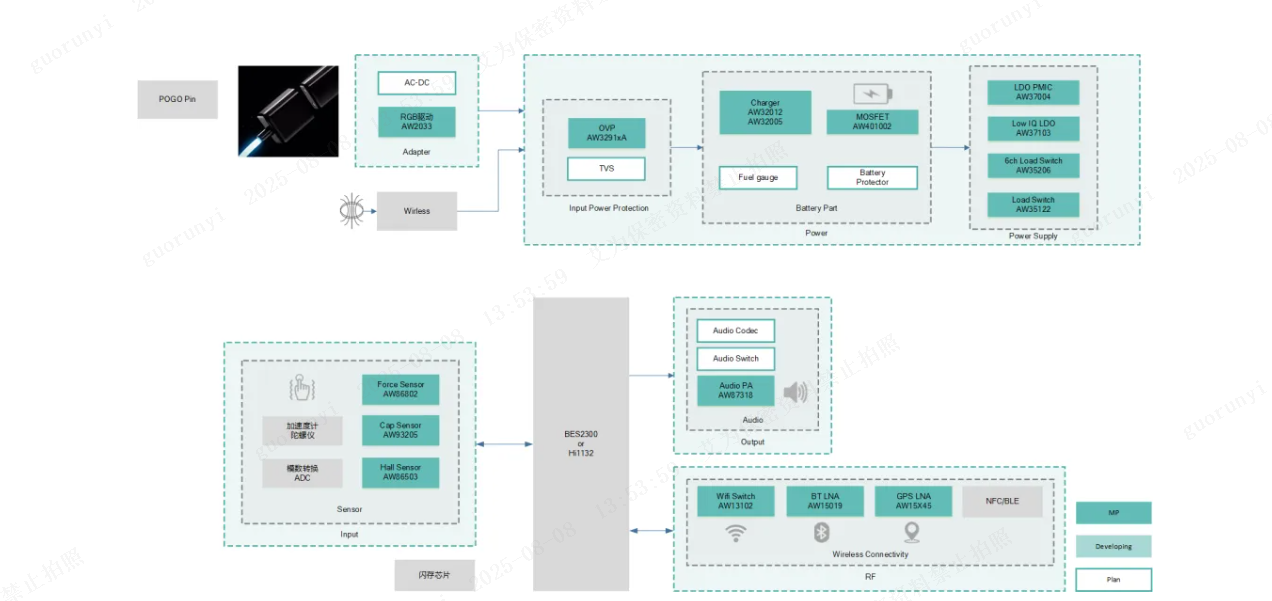
Picture 6 Awinic's application block diagram for smart glasses
In the application field of smart glasses, Awinic chips have a rich product matrix, and the following multiple chips are available for reference.
LDO PMIC Typical Specifications
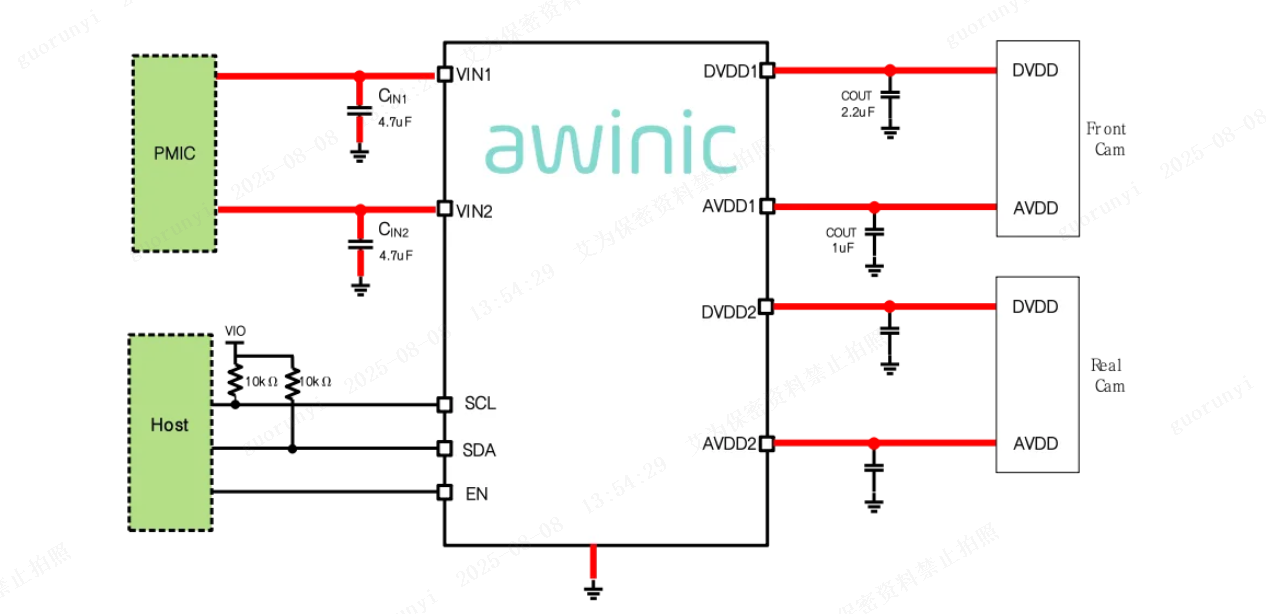
I2C control, 2 power supply channel inputs, 4 LDO channel outputs. Each channel can be independently configured with output voltage, current limiting capability, discharge impedance, power-on sequence, etc. The chip adopts a small DFN 220.75mm -10L package, with a static power consumption as low as 65uA. The chip can be used for CORE and SENSOR voltage supply of camera ISP.
Picture 7 Typical application circuit diagram of LDO PMIC
Force Sensor Typical Specifications
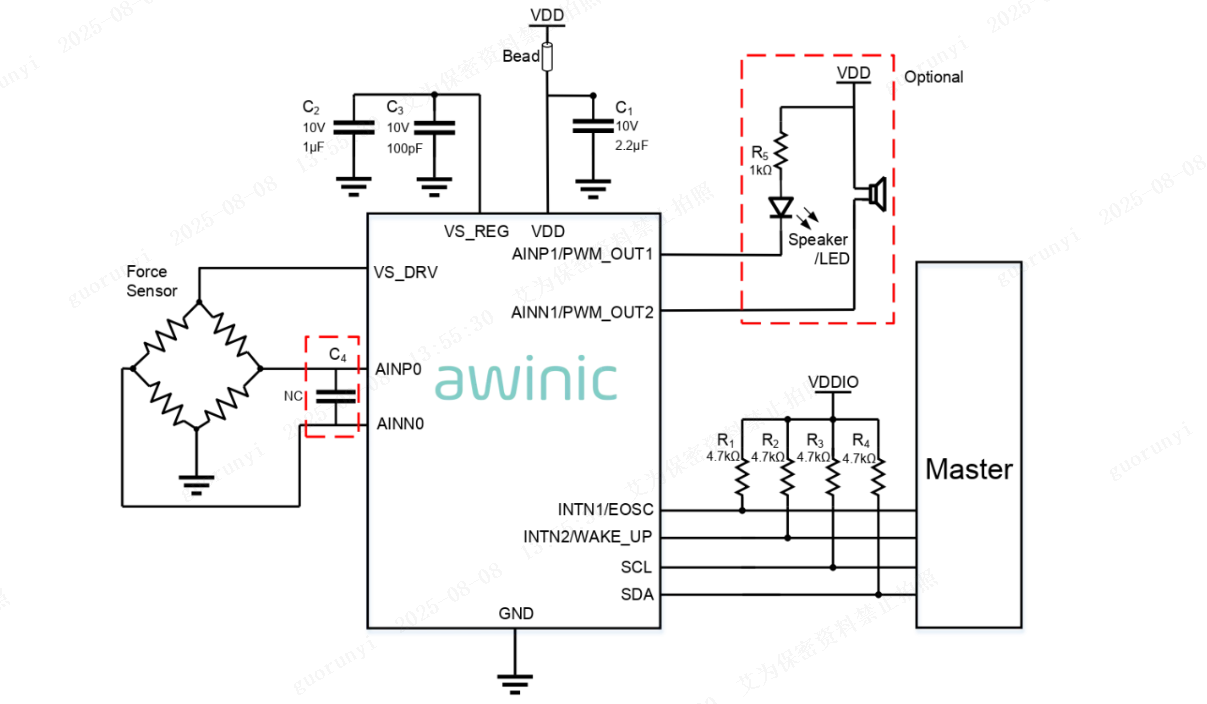
I2C control, supporting 2 independent channels of Asic pressure buttons, supporting 1.2/1.8V IO, gain adjustable from 1 to 256 levels, 150Ksps 14bit ADC sampling rate, WLCSP 1.411.410.34-16B ultra-small package, extremely low power consumption of 10uA @ 10Hz /2 channel. The application of pressure sensing can effectively prevent false touches and improve user experience.
Picture 8 Typical application circuit diagram of pressure-sensitive AFE
Linear Charging IC Typical Specifications
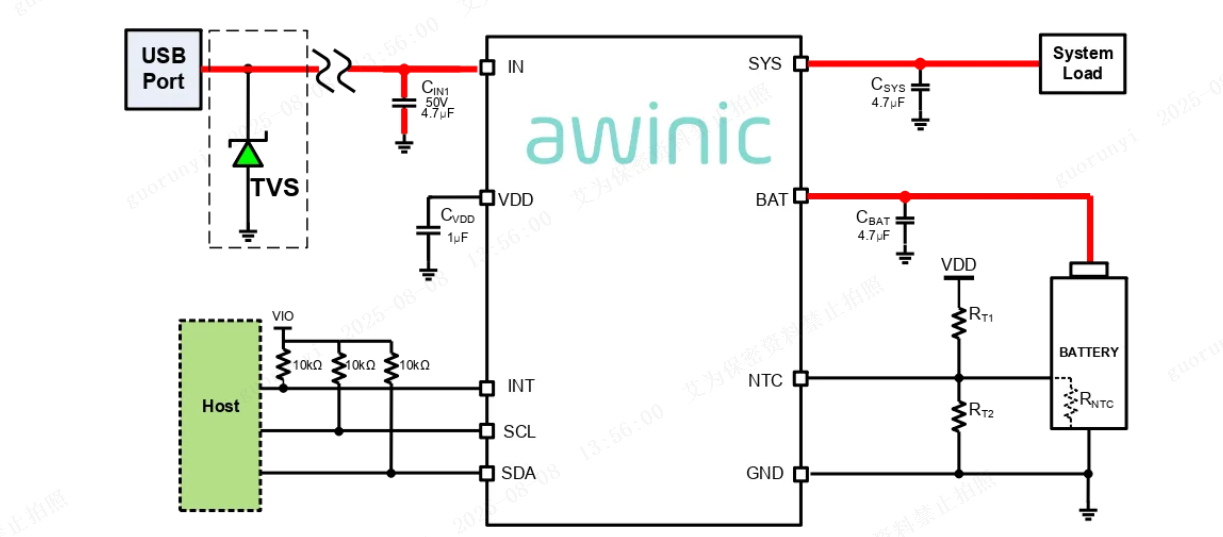
2~500mA charging current can be configured, 28V max DC withstand voltage, ±0.5% charging accuracy, with Powerpath and shipping mode, WLCSP 1.41.40.63 ultra-small package, 8uA IBAT_Q, allowing the battery to be charged more fully and consume less power.
Picture 9 Typical application circuit diagram of linear charging IC
Overvoltage Protection Typical Specifications
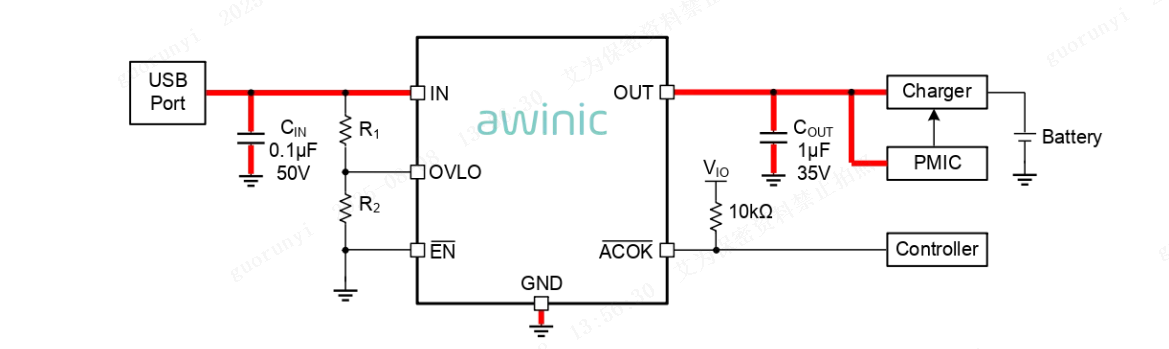
4~24V OVP threshold can be configured, built-in 100V surge capability, 29V DC withstand voltage capability, 100ns fast response shutdown, 27mΩ ultra-small on-resistance, 5A max continuous overcurrent capability. It keeps surges out and reduces after-sales problems.
Picture 10 Typical application circuit diagram of overvoltage protection IC
2025 is known as the first year of smart glasses. AI smart glasses are redefining the way humans perceive and connect with the world. With more glasses products coming to the market in the future, prices dropping to within 1,000 yuan, and the maturity of killer applications such as AI navigation and real-time translation, they are bound to become new popular items. Awinic will continue to deepen in various product lines and strive to create high-quality analog and digital-analog hybrid chips to bring more and better experiences to smart glasses.