With 4K/8K the popularization of ultra-high-definition display technology, TV picture quality has entered a new stage, and audio experience has become a core direction for product experience upgrades. The bottleneck of acoustic design in ultra-thin forms is becoming increasingly prominent. Relying on audio algorithms to break through hardware physical limitations has become the mainstream path for TV audio upgrades. Starting from the technical constraints of TV audio, this article systematically introduces awinicSKTune®_S1 the technical architecture and core modules of audio algorithms, exploring how to unleash the potential of speakers through algorithmic means to achieve a systematic upgrade of the TV audio experience.
01 Technical Constraints and Evolution Trends of TV Audio
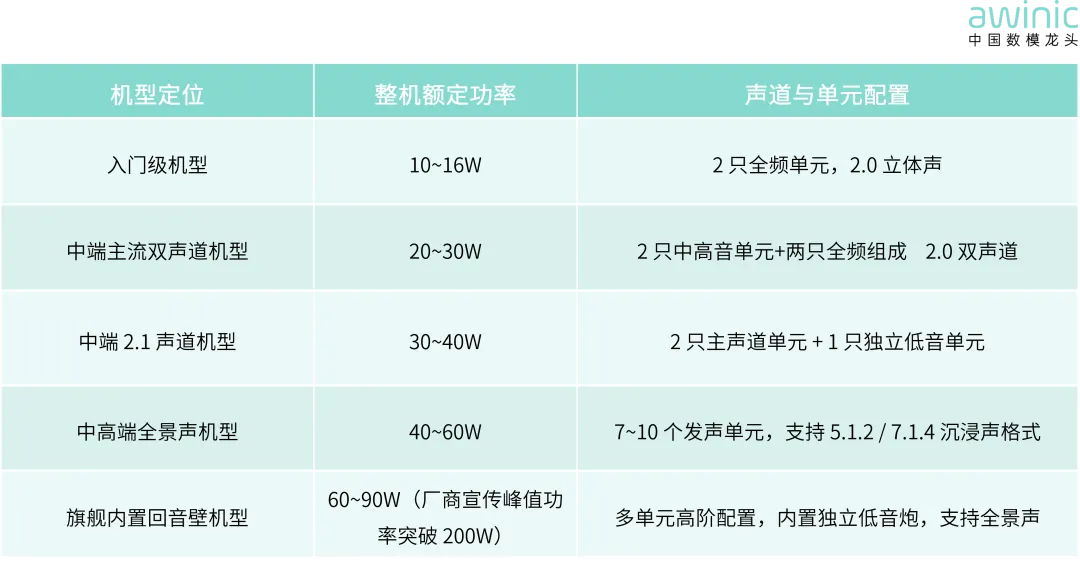
The acoustic design of flat-panel TVs faces a set of structural contradictions: the body thickness has been compressed fromCRTthe era of20cmabove to today's5cmwithin, drastically reducing the space available for speakers. Currently, mainstream home TVs generally adopt bottom or rear-downward placed 2~2.5 -inch full-range units. Limited by both cavity volume and unit diameter, the rated power of speakers shows a clear tiered differentiation:
Meanwhile, on the demand side of TV audio:
· Ultra-thin Trend:Mini-LEDThe trend towards slimness inOLEDTVs has spawned a demand for new types of flat panel speakers.2025In the year, shipments of such ultra-thin modules (thickness≤15mm) reached1,860ten thousand sets. The TV speaker industry as a whole is expected to grow year-on-year by2026in the year10.2%
· Scenario Diversification: Movies (immersive sound field/low-frequency impact), music (fidelity/layering), news (voice clarity), and games (positional localization) impose differentiated and often mutually exclusive parameter requirements on audio systems.
Core bottlenecks at the physical level include: amplitude overload and thermal overload of small-diameter speakers under large signals (rise in voice coil temperature, voice coil displacement exceeding limits causing speaker damage sounds,THDdegradation, etc.); room sound reflection and frequency response distortion caused by different installation methods such as wall-mounting/stands; and the issue that a single fixed parameter set cannot adapt to diverse content scenarios.
02 awinicSKTune®_S1Algorithm System: System Architecture and Core Modules
awinicSKTune®_S1is an audio algorithm platform developed by awinicawinicfor smart TVs,Soundbarand medium-to-high power audio systems (targetingTV/speaker scenarios). Its design philosophy is not simple post-processing enhancement; it can not only use conventional audio processing algorithms but also start acoustic correction by measuring acoustic defects to repair room acoustic defects, while ensuring speakers operate within a safe range through multi-dimensional protection mechanisms.
awinicSKTune®_S1System Architecture
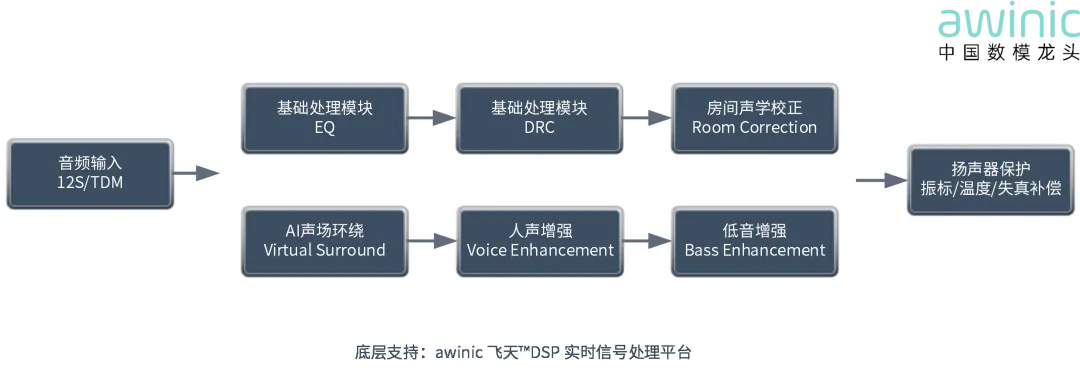
2.1 AISound Field Surround (Virtual Surround)
Technical Issue: Traditional stereo content cannot fully utilize the physical potential of TV multi-channel systems, lacking true spatial immersion.
Technical Principle:awinicSKTune®_S1adopts virtual sound field reconstruction technology based onHRTF(Head-Related Transfer Function). The module uses upmixing technology to separate stereo audio into multi-channel signals (center, lateral, surround) and processes them respectively: the center channel undergoes gain enhancement to improve clarity; the lateral channels/and surround channels use rendering filters to expand the width of the front sound field and enhance surround intensity.
Signal Flow:
1. Input: StereoPCMstream
2. AIContent Classification: UsesAIcontent recognition technology to separate stereo audio into multi-channel signals,
3. HRTFConvolution Processing: Lateral channels/and surround channel signals pass throughHRTFfilter banks to generate multi-channel virtual sound sources
4. Output: Multi-channelPCM(compatible with5.1/7.1physical layout)
Technical Features: Algorithm latency is controlled within10ms, a range acceptable for TV scenarios (<40ms), and does not rely on upstream audio sources to provide multi-channel bitstreams, offering broad compatibility with stereo content.
2.2 Room Acoustic Correction (Room Correction)
Technical Challenge: The actual installation environment of TVs (living room/bedroom, wall-mounted/brackets, furniture layout) is highly uncertain; fixed parameter tuning cannot adapt to all scenarios. Wall-mounted installations are particularly prone to causing mid-to-low frequency response dips and high-frequency comb filtering due to wall reflections, making the sound appear"muddy"or"muffled".
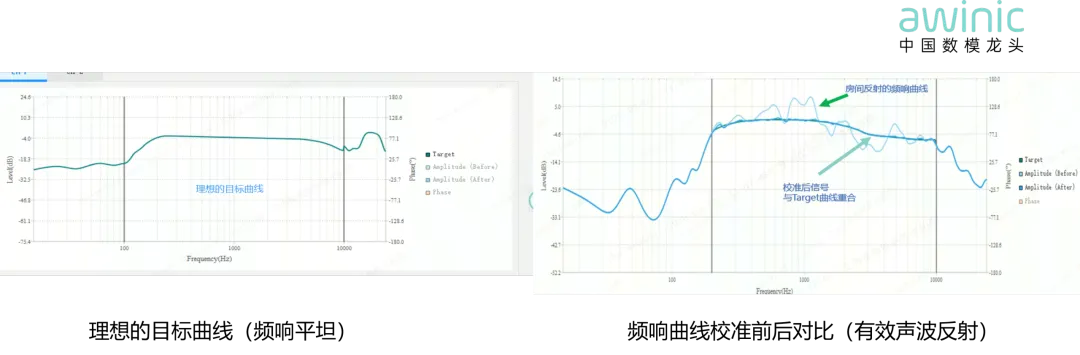
Technical Principle: Based on room impulse response and inverse filter compensation. By analyzing the swept-frequency signal played by the speaker, room acoustic characteristics are extracted. An inverse filter is constructed through analysis algorithms to make the room impulse response≈ideal impulse
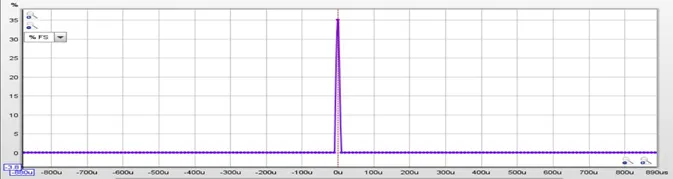
Ideal Impulse Response Diagram
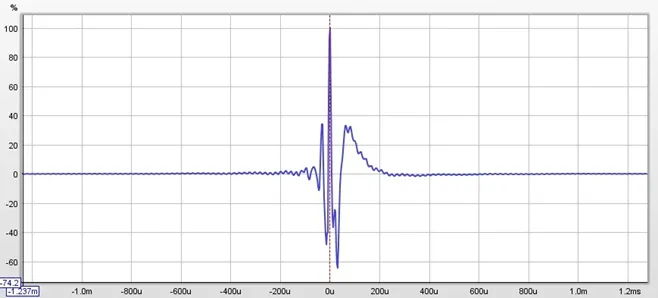
Room Impulse Response
Multi-channel Calibration Process:
1. Each channel independently plays a swept-frequency excitation signal
2. Microphone array (or built-in feedback path) captures the room response
3. Estimate the impulse response from each speaker to the listening position h_room(t)
4. Magnitude Alignment: Ensure smooth magnitude across all channels
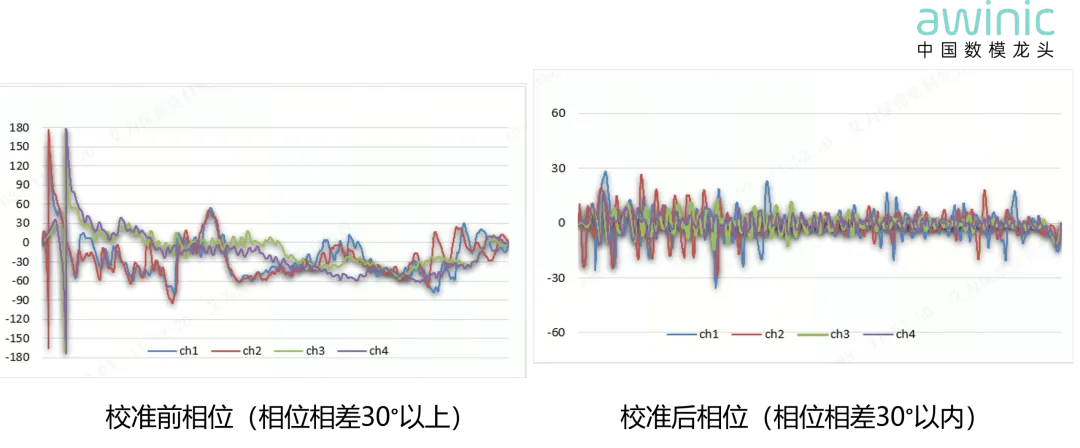
5. Phase Correction: Compensate for phase differences caused by physical position variations to avoid sound image shift and comb filtering
Before and After Comparison of Room Acoustic Correction
2.3 AIVoice Enhancement (AI Voice Enhancement)
Common Pain Point: In programs such as sports events, reality shows, and documentaries, environmental background sounds (cheering, music, natural sounds) often mask human voices, resulting in insufficient dialogue clarity. TraditionalEQmethods highlight human voices by boosting mid-frequency gain (typically1-4kHz), but the side effect is that background noise is amplified simultaneously, and adaptability to speakers with different pitches is poor.
Technical Principle: Based onAIcontent recognition technology. The algorithm decomposes the input signal during upmixing, extracts human voices via side-chain processing, and then applies independent dynamic gain control to the voice components, while non-voice components maintain their original levels.
Signal Processing Chain:
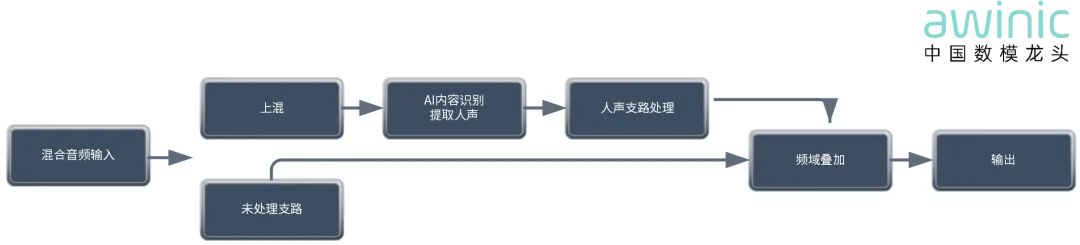
Technical Advantages: Compared to broadbandEQsolutions, this method offers frequency selectivity——enhancing only the energy belonging to the human voice spectral components, thereby avoiding the issue where"background noise increases along with the human voice". It also supports ratio adjustment.
2.4 Non-linear Distortion Compensation (THD Compensation)
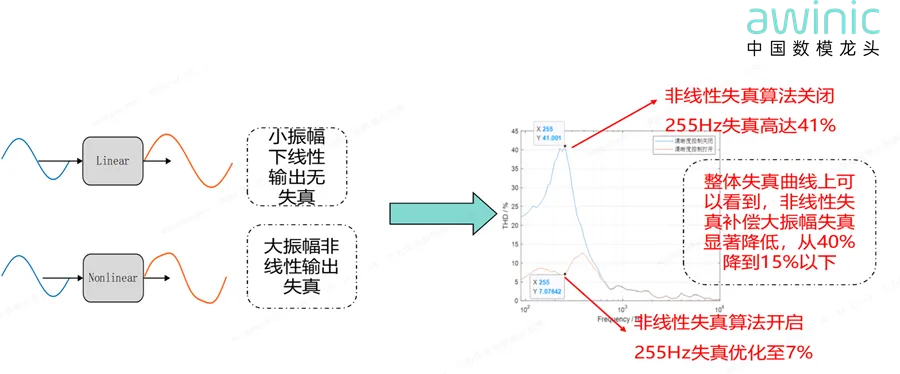
Common Pain Point: The widespread use of large-excursion speakers and high-power amplifiers has significantly improved the sound reproduction effects of smart speakers, but it has also introduced obvious non-linear distortion issues, leading to reduced clarity and affecting user listening experience and low-frequency performance.
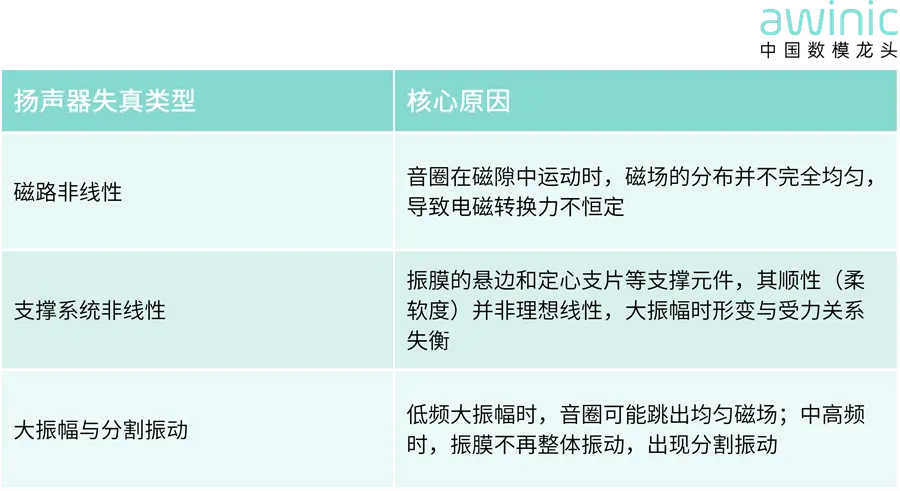
Technical Principle: Pre-distortion compensation based on a speaker physical model. The algorithm constructs an inverse non-linear model of the speaker by modeling the functional relationships of key non-linear parameters. Before the signal is sent to the amplifier, the input signal undergoes pre-distortion processing through the inverse model, so that after passing through the speaker's non-linear system, the final radiated acoustic signal approximates an ideal linear response.
Non-linear Distortion CompensationPath
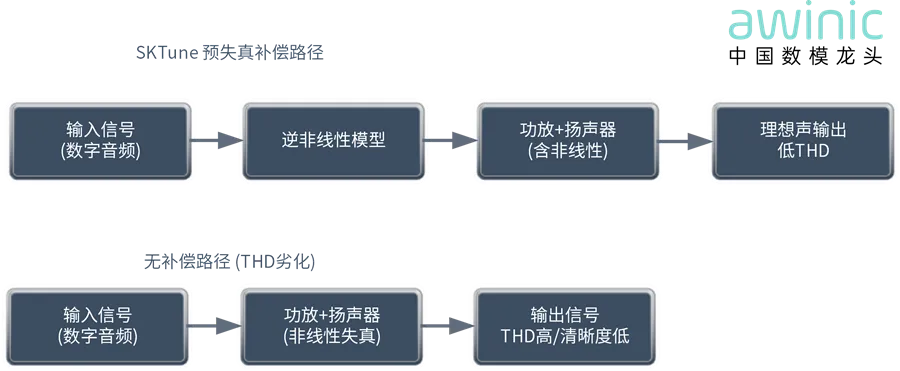
Compensation Effect: Under typical operating conditions,THDis significantly reduced, and the low-frequency dynamic range is improved by approximately2-3dB.
2.5 Hardware Implementation Platform:AW858Series and Feitian™DSP
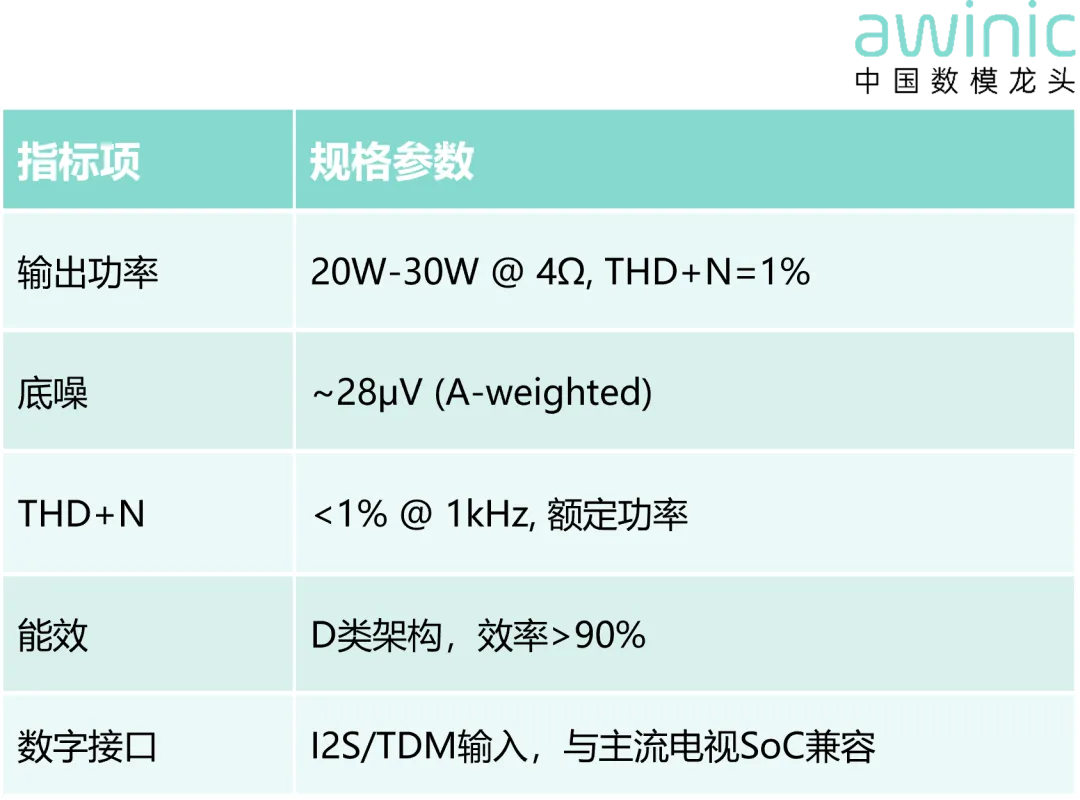
awinicSKTune®_S1Some algorithms run onawinicawinic's self-developed Feitian™DSP, whichDSPis integrated intoAW85805/AW85815and other medium-to-high power digitalDIn Class-D amplifier chips. Key metrics of the hardware platform are as follows:
03 awinicFull-Chain Audio Layout and Industry Practices
awinicThe layout in the audio field covers the complete chain from chips to algorithms:
· Hardware Layer: Audio Power Amplifiers (Smart K/D,Medium K Auto KClass),ADC/DAC,Codec, Audio Bus Interface Chips
· Algorithm Layer:awinicSKTune®Series Sound Effect Algorithms (Mobile/Wearables/TV/Automotive Multi-Platform)
To date,awinicawinic's cumulative audio chip shipments have exceeded120100 million units, and end devices equipped withawinicawinic algorithms exceed20100 million units. In the TV audio sector,awinicawinic provides an integrated solution of"AW858hardware platforms + FeitianDSP + awinicSKTune®_S1algorithms", supporting customers with rapid adoption throughout the entire process from prototype evaluation to mass production tuning.
04 Conclusion
The competitive dimension of the TV industry is shifting from"single-point breakthroughs in picture quality"to"comprehensive audio-visual experiences". Under the premise of limited physical space, algorithms have become the core lever for TV audio upgrades. They systematically enhance soundstage performance, vocal clarity, and low-frequency dynamics under limited hardware conditions, providing a complete solution for TV manufacturers.