Article reposted
from Jiwei-net
From March 25 to 27, the 21st Automotive
Lighting Industry Development Technology Forum and Shanghai International
Automotive Lighting Exhibition (ALE) was grandly held in Kunshan, Jiangsu,
where intelligent vehicle lighting and interactive technologies took center
stage. As a leading Chinese analog and mixed-signal company, awinic Technology
made a major appearance at the event with comprehensive solutions spanning
in-cabin ambient lighting and exterior intelligent vehicle lighting. Leveraging
16 years of expertise in automotive lighting communication technology and its
full-stack product portfolio, the company garnered significant industry
attention. During the exhibition, a representative from awinic Technology
accepted an exclusive interview with Jiweinet, offering in-depth insights into
automotive lighting technology trends, the core advantages of domestic
substitution, and future R&D strategies.
Technology Renewal: Full-Scenario
Product Matrix Drives Interactive Upgrades
As a vital aspect of automotive intelligence, vehicle lighting has evolved from
a mere illumination tool into a core medium for emotional interaction and
personalized expression. At this year’s ALE exhibition, Awinic Technology
showcased a renewed suite of solutions for both interior and exterior
applications, centered on "intelligent interaction."
"With 16 years of deep expertise in
LED lighting communication technology, we have introduced a full-series LED
driver product matrix ranging from 3 to 216 channels, forming a differentiated
'Awinic Lighting Communication' technology system," the representative
explained. The core solutions presented at the exhibition included static and
dynamic ambient lighting, ISD interactive taillights, starlight headliners, and
a groundbreaking, industry-leading dedicated solution for in-car music rhythm
synchronization—fully addressing the evolving demands for intelligent lighting
interaction.
Among these, the
in-car music rhythm & AI emotional ambient lighting stood out as a star
product and solution, creating an immersive lighting interaction experience for
intelligent cockpits and drawing significant interest from visitors. The Awinic
Technology representative noted that this solution leverages AI music style
recognition technology to instantly analyze music genres and automatically
match lighting effects. By employing both time-domain and frequency-domain
analysis, it achieves ultra-low-latency, precise synchronization of sound and
light, deeply integrating cockpit ambient lighting with music. Complemented by
a real-time screen color tracking algorithm, it automatically generates
adaptive lighting effects based on the screen’s dominant hue, ensuring a highly
cohesive interior color scheme. This approach moves beyond monotonous, rigid
lighting, elevating traditional cockpit illumination into a "warm,
emotional, and atmospheric" cabin experience. The solution is widely
adaptable for automotive applications such as AI-based music style recognition
and full-scenario cockpit ambient lighting. It incorporates Awinic Technology’s
music rhythm MCU AW32F010QNR-Q1, 36-channel true-color RGB constant-current
driver AW21036QPY-Q1, and static ambient lighting SoC AW23003QNR-Q1.
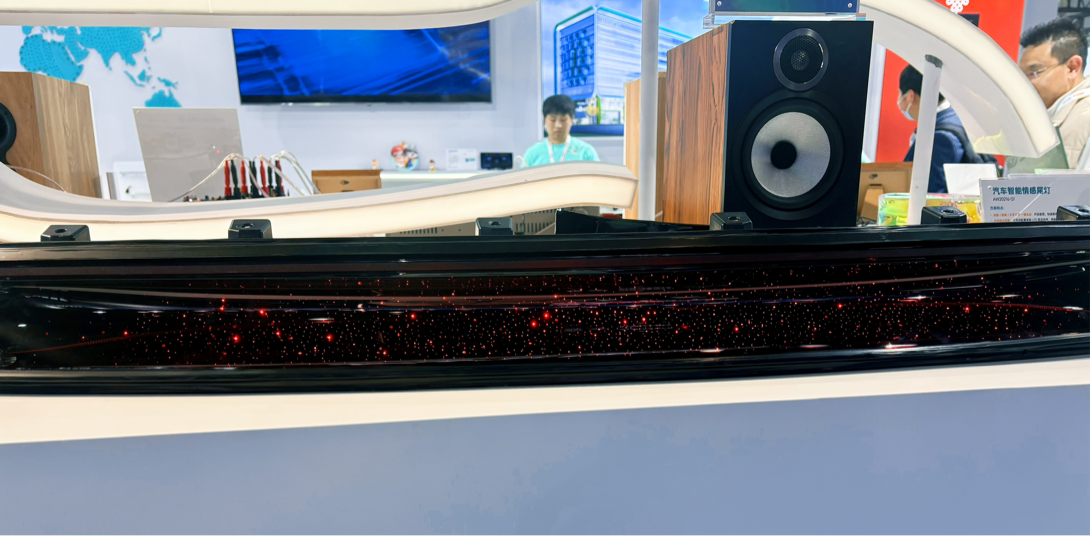
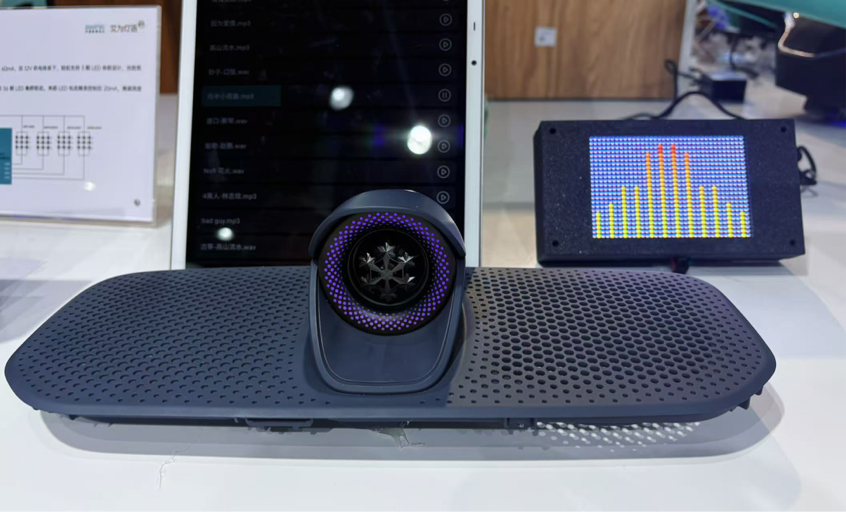
(On-site photo
of in-car music rhythm & AI emotional ambient lighting)
The AW32F010QNR-Q1 pairs perfectly with
the 216-channel matrix LED driver chip AW20216EQPY-Q1. The latter can
independently control 216 monochrome LEDs or 72 RGB LEDs with a single chip,
with each channel supporting 256-level DC current adjustment and 256-level PWM
dimming. This enables 16.78 million color adjustments, supports an autonomous
breathing mode, and features a built-in comprehensive diagnostic module. The
combined solution can effortlessly realize high-end scenario applications such
as dynamic music rhythm synchronization, starlight headliners, and intelligent
interactive lighting.
The reporter also learned that the
AW20216EQPY-Q1 utilizes an 18*12 LED driver design, coupled with a 10MHz SPI
high-speed communication interface, achieving extremely fast animation refresh
rates for lighting effects without stuttering or ghosting. In common taillight
screen applications with 2,000 to 5,000 LED beads, this solution requires only
10 to 25 driver chips, significantly reducing hardware costs and PCB complexity
compared to the 42 to 105 chips needed in traditional solutions.
Demand Evolution: A Triple Shift from
Feature Stacking to Emotional Interaction
Awinic Technology's continuous launch of
highly integrated, high-performance product matrices is driven by its keen
insight into the profound evolution of industry demands. As automotive lighting
transitions from a high-end option to a standard feature, industry data
projects that ambient lighting penetration will reach 80% by 2028, with 10 to
40 units installed per vehicle. Against this backdrop, the demands of OEMs and
Tier 1 suppliers are undergoing significant transformation.
The representative summarized, "The
current industry demand exhibits three core shifts. First, the shift from
'feature stacking' to 'emotional interaction.' Lighting is no longer merely
decorative but has become a central medium for human-vehicle interaction. This
requires not only emotional interaction based on occupant heart rate, fatigue
level, and music style but also cross-domain integration with intelligent
driving alerts, infotainment systems, and fragrance systems. Second,
personalization and user co-creation have become core demands. OEMs urgently
need lighting solutions that support customizable colors, dynamic effects, and
trigger logic. Third, high-lumen ambient lighting is becoming the mainstream standard,
placing higher demands on driver chip integration, reliability, high-current
control capability, and compact packaging."
This trend aligns closely with the
intelligent and electrification transformation of the automotive industry. Data
shows that in 2025, China's new energy vehicle (NEV) production and sales
exceeded 16 million units for the first time, accounting for 47.94% of total
vehicle sales. Some analysts predict that penetration could reach 80% by 2030.
NEV manufacturers have higher demands for design freedom, technological
sophistication, and intelligent interaction in lighting, and are also more
willing to experiment with local supply chains, creating vast opportunities for
domestic companies like awinic Technology.
Addressing Application Challenges:
Software-Hardware Synergy Solves Industry Pain Points
In response to the upgrade demand for
in-cabin ambient lighting from "decoration" to "dynamic
interaction," Awinic Technology has developed a full-chain optimization
solution. At the color control level, the automotive-grade LIN RGB SoC
AW23003QNR-Q1 stands out. It integrates three constant-current drivers, each
supporting 256-level current adjustment and 65,536-level ultra-high-precision
PWM dimming. Combined with its proprietary high-precision spatial color
conversion and LED temperature compensation algorithms, it achieves color
consistency under all operating conditions, with target color coordinate
deviation controlled within ±0.005, far exceeding standard industry levels.
In terms of dynamic effects and system
design, the high integration of the AW20216EQPY-Q1 is a key advantage. A single
chip can drive 216 LEDs, reducing system costs by over 20% compared to
conventional solutions. Paired with LIN bus single-bus, multi-node control
capability, it significantly simplifies vehicle wiring harness layout.
Meanwhile, the music rhythm-dedicated MCU AW32F010QNR-Q1 supports multiple
differential signal inputs, compatible with PA differential output, MIC output,
and HEADPHONE output. It requires only one IIC bus to connect four
AW21036QPY-Q1 chips, controlling up to 144 LED channels to achieve smooth,
seamless sound and light synchronization.
Addressing pain points in exterior
intelligent vehicle lighting—such as high power density, high heat dissipation,
and high communication rates—Awinic Technology also offers targeted solutions.
The AW20216EQPY-Q1 delivers a transient current of up to 100mA per channel,
supporting independent constant-current dimming and PWM dimming, making it
ideal for applications like Mini LED taillights and ISD interactive taillights.
It adopts an automotive-grade QFP package and a large thermal pad, capable of
withstanding a wide temperature range from -40°C to +125°C, meeting the
stringent requirements of exterior automotive environments. For reliability,
the chip integrates monitoring and protection functions for conditions like LED
open/short circuits and over-temperature. It is AEC-Q100 Grade 1 qualified, and
the entire process—from design and packaging to testing—complies with
automotive-grade quality management standards.
Domestic Substitution: Three Core
Strengths Forge Competitive Barriers
The ability to confidently address
multi-scenario challenges stems from the robust barriers Awinic Technology has
established in the automotive electronics sector. The triple transformations of
electrification, intelligence, and global expansion in the automotive industry,
coupled with policy support for domestic substitution, have solidified Awinic
Technology's first-mover advantage, creating a strong competitive edge in
automotive electronics.
The on-site representative summarized
this advantage as resting on three core pillars: "technological expertise,
service responsiveness, and supply chain security."
On the technology front, awinic
Technology has focused on R&D in high-performance analog and mixed-signal,
power management, and signal chain chips for 18 years. It has built a
comprehensive portfolio spanning five major product lines ("sound, light,
electricity, shooter, and driver"), over 40 product subcategories, and
nearly 2,000 products available on the market. Specifically in automotive
lighting drivers, the company boasts 16 years of accumulated experience,
offering full-stack solutions from chips to systems.
In 2024, Awinic Technology's R&D investment
reached RMB 510 million, accounting for nearly 17% of its revenue, with
technical staff comprising over 74% of its workforce. In 2025, the company
continued to increase R&D investment, with R&D expenses in the first
half of the year rising 19.2% year-on-year to RMB 263 million. It has
accumulated 684 domestic and international patents, 131 software copyrights,
and 610 integrated circuit layout registrations, demonstrating industry-leading
innovation investment and technological strength.
Regarding service responsiveness, Awinic
Technology has established technical support centers in Shanghai, Beijing,
Shenzhen, Xi'an, Chengdu, as well as in South Korea and North America. This
enables rapid response to customer needs throughout the R&D, debugging, and
mass production processes, offering greater flexibility and efficiency
advantages compared to international manufacturers.
In terms of
supply chain and quality assurance, Awinic Technology has formed deep strategic
partnerships with leading domestic wafer fabs and packaging/testing houses,
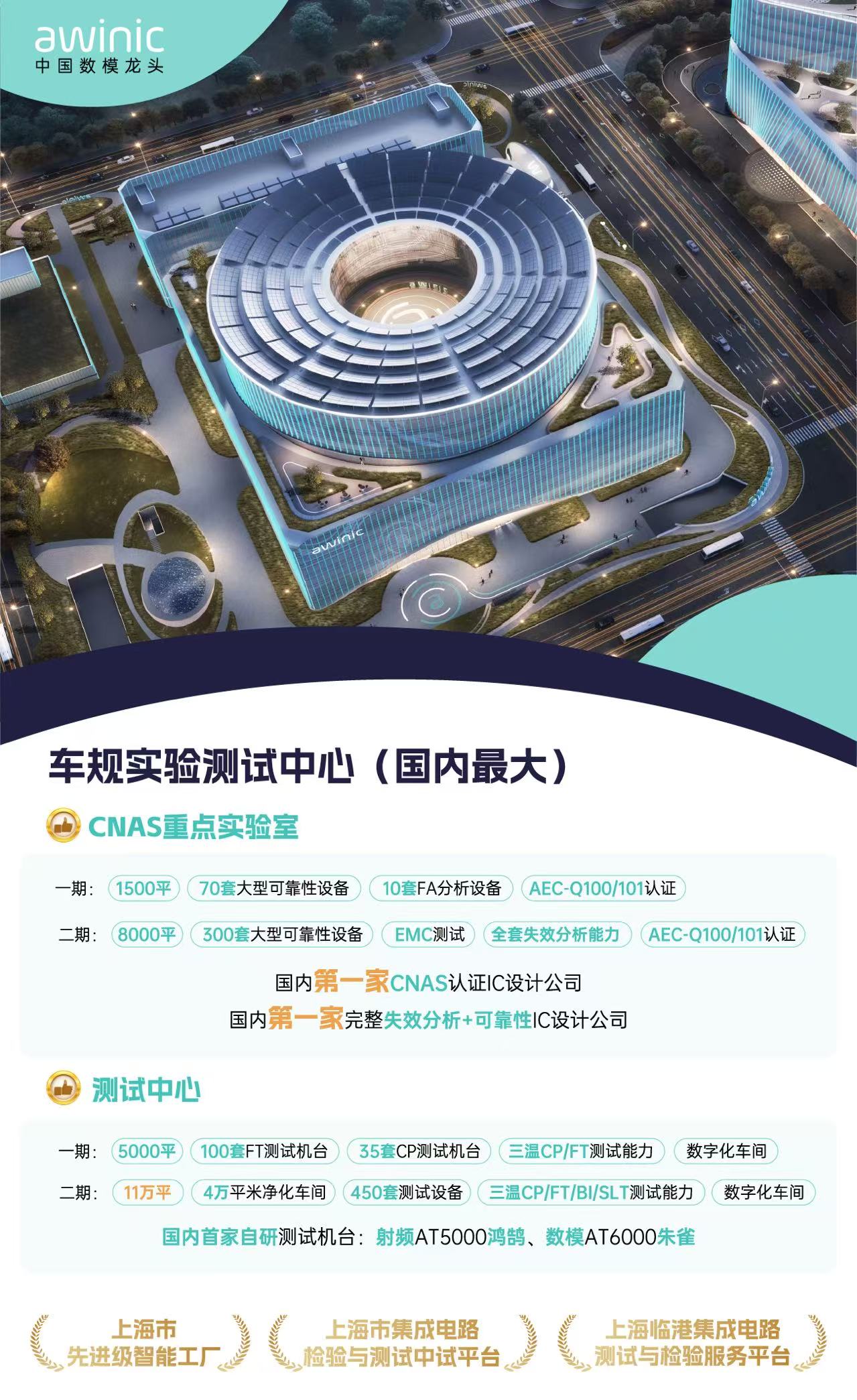
establishing a stable and independent supply chain. It operates the first
CNAS-accredited integrated circuit reliability and FA analysis laboratory among
Chinese IC design companies, possessing comprehensive in-house capabilities for
reliability verification and failure analysis. The company has also built a
6,000-square-meter automotive-grade testing center (with a second phase of
110,000 square meters scheduled for operation in 2026), supporting
automotive-grade three-temperature testing and full AEC-Q100 qualification
testing, achieving full lifecycle quality control from design to mass
production. Additionally, the company has obtained IATF 16949:2016 automotive
quality management system certification and ISO 26262:2018 ASIL D certification
(the highest level for automotive functional safety), providing a solid
guarantee for product reliability.
At present, Awinic
Technology's solutions—including static and dynamic ambient lighting, music
rhythm synchronization, and ISD interactive lighting—have been widely adopted
by major domestic automakers such as BYD, Harmony Intelligence Mobility,
Xiaomi, GAC (including Hyptec), Changan (including Avatr), Chery, and
Leapmotor, as well as leading Tier 1 suppliers. Several core products have
achieved mass production. Among them, five products, including the
automotive-grade audio amplifier chip AW85601QPR-Q1 and the ambient lighting
chip AW23003QNR-Q1, have been successfully included in the 2025 China
Automotive Chip Supply Manual. Throughout the process of integrating into
mainstream automakers' supply chains, Awinic Technology has passed rigorous,
multi-dimensional evaluations by customers, leveraging its long-term supply
reliability and business continuity, establishing itself as a benchmark
enterprise for domestic automotive chip substitution.
Future Layout: On-Device AI +
Full-Scenario Collaboration Ushers in a New Era
When asked about future breakthrough
points in automotive lighting chip technology, Awinic Technology stated,
"The core focus will be on two main directions: 'emotionally intelligent
interaction empowered by on-device AI' and 'full-scenario collaboration between
interior and exterior lighting.' Lighting will be thoroughly upgraded into a
core intelligent medium for human-vehicle interaction and vehicle-to-everything
(V2X) communication, achieving a leap from 'passive response' to 'active
perception and intelligent adaptation.'"
Based on this vision, Awinic Technology
has initiated forward-looking R&D initiatives: In the field of on-device
AI-driven lighting interaction, the company is focusing on developing AI
emotional interaction ambient lighting solutions. By integrating multi-sensor
data from the cockpit—such as facial recognition, heart rate monitoring, and
fatigue detection—these solutions will enable real-time analysis of occupant
emotions and proactive adaptation of lighting effects. In music rhythm
technology, the company has achieved a breakthrough in AI-based music genre
recognition, enabling automatic matching of lighting effect modes and color
schemes based on musical style. Future iterations will continue to refine
on-device AI music rhythm algorithms. In the area of full-scenario
collaboration, Awinic is advancing the development of high-partition Mini LED
drivers, automotive-grade high-speed bus drivers, and multi-domain
collaborative lighting control chips to achieve seamless coordination between
in-cabin ambient lighting, exterior interactive lighting, and intelligent
driving systems.
Awinic Technology's long-term goal is to
achieve automotive electronics revenue accounting for 20% of its total by
2029-2030. To this end, the company plans to successively launch new products,
including CAN/LIN dynamic ambient lighting SoCs, dedicated Mini LED drivers,
and on-device AI music rhythm chips, further refining its automotive-grade
product portfolio.
Amidst the wave
of electrification and intelligent transformation in the automotive industry,
intelligent vehicle lighting, as a core interactive medium, is experiencing
continuous market growth and escalating technological value. Leveraging its
deep technological expertise, full-scenario product portfolio, and
independently controllable supply chain system, Awinic Technology is steadily
transitioning from consumer electronics to the high-value field of automotive
electronics. Looking ahead, this leading Chinese analog and mixed-signal
company will provide the global automotive industry with more competitive
"China Chip" solutions, propelling the intelligent vehicle lighting
sector into a new era of emotional, intelligent development.